Paddle to Seattle is an entertaining film about two friends as they build their own kayaks and paddle together for 97 days through the wilderness on a journey from Alaska to Seattle. It's available on DVD (or buy it in Europe from Justine), but now for a limited time also streaming live until January, 25th. 2011 on PBS. Enjoy it, have a good time with Josh Thomas and J.J. Kelley!
ANP-news December, 6th: This weekend it was colder in the Netherlands than in Canada and West-Greenland. Quit unusual.
These days ice makes paddling impossible on the channels and lakes around Woerden. And I noticed that the cold weather keeps more (otherwise winter-proof-) paddlers inside. Ice-skating is no alternative, the ice conditions are poor due tot the wind and the snow. Followers of my Facebook-pages will have noticed that I take up biking again. Not on the road (too slippery, too much salt for the road racing bicycle), but off-road with the mountain-bike. Often I bike with another canoe-enthusiast, it's good fun playing in the snow. On the link-list I've added a category for the bike-blogs I like. The first blogs in the lists are the blog of Rose - a passionate Dutch road cyclist who now also is discovering the fun of cycling off-road and the blog of Jill, a real adventure cyclist - living in the Western part of Montana. Compared to the conditions in Montana our winter is peanuts and winter-biking here is child's play compared the trips Jill makes in the fantastic scenery of the Mountains in Montana! (note: Wanderlust!).
How to survive the cold? Learn about it in "the Polar Night of Groningen". This winter the city of Groningen is a polar city. During a lively festival you can visit several exhibitions, attend public lectures, meet polar scientists, experience the polar night, win a trip to Spitsbergen and see lots of polar movies!
The festival is organized to bring the Polar Regions, and all it’s aspects, closer to the public. Groningen also celebrates the 40th anniversary of the Arctic Centre at the University. Together with colleague polar scientists and organizations such as WWF, Blikveld and KNNV publisher the Arctic Centre organizes the ‘Poolnacht van Groningen’ [Polar Night of Groningen] from November 15th 2010 until January 15th 2011.
One of the many highlights of the festival is the exposition "Faces of Greenland" with b&w-pictures of Ko de Korte.
Biologist Ko de Korte and his colleagues spent the field seasons of 1973-1975 in the Scoresby Sund area, studying breeding birds on the tundra. The researchers were warmly welcomed by the people of Ittoqqortoormiit, who invited them into their homes and shared with them their stories as well as the meat of animals they had hunted in and around the fjord.
Being intrigued by the Inuit people and their impressive way of life, Ko de Korte photographed them. Building upon his relations with these people, he portrayed them during the daily activities in their natural environment, capturing the essence of life in Ittoqqortoormiit.
Faces of the Scoresby Sund shows not only the strength and perseverance of these people, but also the joys and hardships of living in one of the most extreme outposts of the Arctic.
This evening the small village of Noordlaren (located in the northern part of the Netherlands, in Groningen) had this year's première of a speed skating race on natural ice. A few nights of frost is all the Dutch need to get completely mad about speed skating. To be fair I am no exception, although I am also a bit disappointed that my Tuesday-evening kayak routine stops this early this winter. The water around the boathouse of the local kayakclub in Woerden iss covered with ice since this morning. It's not enough ice to skate, but enough ice to make paddling impossible. I hope this "ice-break" won't last as long as it did last year (in the winter of 2009-2010 it was 7 weeks impossible to paddle around Woerden).
Paddling (and biking) buddy Alex helps me to get over my deception: tomorrow-evening we are not going to paddle, but are going to skate (on the indoor ice track of Utrecht)!
My daughter Lieke made the first rolls this evening in the swimming pool of the Alphense Kanovereniging the Kromme Aar. At the first session a few weeks ago I worked with Lieke on the balace brace, and we finished with a "lightly assisted" butterfly roll. Today, at the second session, Lieke progressed from the buttterfly roll to the standard Greenland roll. The technique needs some finetuning, but the roll is already quit solid. Lieke is a totally different learner compared to her brother Jelle. Jelle is an explosive, agressive hip-flic roller, while Lieke's focus is more on gentle body movements. Jelle first learned the hand-roll and is still convinced a paddle only makes rolling harder...
Groningen was to become one of the first cities in the world with free wireless internet throughout the city. But the implementation of the wireless network was (too) complex, got delayed and now the project is finally cancelled. And just today (to be even more specific: this afternoon at half past two) 22 years ago, the Netherlands were connected to the Internet as the second country in the world (after the USA). Thanks to Piet Beertema, system administrator of CWI (with this name undoubtedly with roots from Groningen), whose good international contacts played an important role. Two years earlier he registered the first country code: .nl So you see: "...er gaat niets boven Groningen" - Groningen tops it all.
Every paddler with a little bit of experience knows that low head dams (weirs) are dangerous, potentially lethal. Though you won't find serious white water in the flat Netherlands (the one exception is DWD), the canals in the country are full with hydraulic engineering installations, such as artificial weirs, pumping stations, inlets et cetera, creating potentially dangerous situations. And accidents happen; an example with huge impact was 2 years ago on the river de Berkel, where two people drowned in the water flow behind a low head dam.
Dutch engineers of the consultancy firm Oranjewoud developed a simple but effective solution that claims to take away the risk of drowning at low head dams: the Safety-slide. Two weeks ago the first Safety-slide was put into use at the low head dam in the canal de Nieuwe Wetering near Laag Zuthem. At the occasion of the official opening a team of NKB-WW-coaches did a safety test in the flow behind the dam and demonstrated the effectiveness of the Safety-slide.
Note: Dutch engineers are businessmen: the Safety-Slide is patent-protected, patent number: 1036143.
Video by Wieger, kayakers in the clip: Wieger, Anoushka, Chris (no Hans... ;-() Anoushka is regularly sending invitations to join the surf sessions in Bakkum. Alas it's a relative long drive from Woerden to Bakkum and in the weekend there are too often too many obligations/excuses not to go paddling - so it's a long time ago I surfed in Bakkum. The last time I did was quit memorable..
This week Anoushka attached a link to this nice video in the mail. I love to share it. It's so tempting! I want surf! Next time, no more excuses: I join the enthusiast friends in Makkum!
Kayakclub Ossa: 2 weeks ago Freek, Andre and I were invited to do a rolling clinic - Greenland-style - in Heerhugowaard. We enjoyed working with enthusiast and talented participants. Thanks to Ria for the organisation! More pictures and videos in the Picasaweb Album of KV Ossa.
David Fincher's film, about the founder(s) of the social-networking website Facebook, makes its début in the Dutch theatres this week, on October, 28th. I expect to welcome my 200st friend on Facebook before the end of the week...
It took some time for me to discover and understand the idea, the benefits and the fun of Facebook, but during the last months I started to appreciate the possibilities of this social medium. In the beginning I was puzzling what was the surplus value of the Facebook account above the weblog. I am still not quit sure, I associate it with keywords like easy, fast, responsive, interactive, common interest, personal, network, sharing. But also issues as privacy, big brother, flood of irrelevant notifications, commercialization, desultory, ego-trip do come in my mind. I have a tendency to look for rational arguments for what I am doing: I am the kind of guy that studies the manual first before he starts playing with a new toys. I want to read a quality city-guide before I start my journey... Regarding the world of computers and the Web2.0 however, I am beginning to realize the need for a different approach: the system of just trying, let it go, see what it brings... This is no plea for naivety nor simplicity: a sound suspicion is at its place regarding the (intentions of the) Zuckerbergs, Pages and Brins, Gates and Jobs of this world! Said this, I enjoy my Facebook community. It's a great way to stay in contact with relations all over the world. In recent times I am more frequently posting and commenting and am getting more responses on the Facebook account than on this weblog. Consequently the character of this weblog changes: more accent on timeless items and less on spontaneous mind-bubbles.
I digress. Sorry. After this (too long) introduction: I started writing todays' post to bring attention to an initiative of a good kayak-friend and colleague in the Dutch seakayaking commitee Ad Moerman. Ad is pushing a new platform for Dutch seakayakers: De digitale hangplek voor zeekajakkers. Despite the archaic title and the connotations which Ad uses for this platform (hangplek = meeting place to chat and hang around, dorpspomp = parish/village pump) it is really Web2.0: an application that facilitates interactive information sharing, interoperability, user-centered design, and collaboration on the World Wide Web. Or to put it simple: Ad has created a Facebook-group for active seakayakers in the Netherlands: Voorwaartse Slag!!! All that's needed to join is a Facebook account - don't be too afraid for mr. Zuckerberg!
One of the "lessons learnt" in the Dutch seakayaking-incident last June regards trip-preparation: the importance of a proper orientation on to be expected conditions of weather, wind and waves. It may sound all very obvious, but it proves to be neglected easily... Standing on the beach, sheltered by the dunes conditions may look harmless, but what can you expect some miles out, a few hours later?
Axel has designed a helpful tool for Dutch seakayakers: "Vaarweer" - a weather widget that gives direct access to actual weather reports, wave statistics and tidal predictions for the most popular paddling destinations along the Dutch coast. I've put a link to Vaarweer in the lists of boormarks on the left side of the Kajakwoerden-weblog. Axel says (invites you to...) that (provided you are a bit more handy with internet-applications than I am..) it's also possible to integrate a Vaarweer-widget on any website.
Compared to 10-15 years ago there is much easier access to more, better and more specific information about the weather. Now it's about the skill how to interpret this amount of information!
As I put on my drysuit last Tuesday-evening, the neck gasket tore. First I was a bit disappointed because I was so excited to do a rolling session with a new kayak that I am reviewing at the moment. The vulnerability of the latex-seals of a drysuit is an issue, but don't dramatize it: unless your planning a long swim- or diving party, even with a broken neck gasket a drysuit offers quit a lot of protection: I put the hood of the Kokatat-GTX-Expedition-drysuit on, pulled the cords tight and could do 10-15 rolls before I noticed the first water intrusion. Nevertheless: I want my drysuit to be dry - so it's time for a repair.
At a closer look I noticed another little tear in the top-end of the neck gasket and that the gasket is dried out at the end. So actually it's time for a replacement (the second one in 2-3 years). I am going to order a new neck seal, but first I used this occasion to check if I manage to repair the neck seal with simple means. I want to check if it's possible to do a quick provisional repair when I have a misfortune like this on a trip.
My bike repair kit stores the essentials for the repair: glue (TipTop blue- solutie/rubber glue: I use the blue professional one - but the standard bike-tyre repair glue must also do), a piece of an old inner tube to cut off some patches, and a piece of sand paper to scrape the gasket and the patches for better adhesion. The pair of scissors isn't in the picture. Repairing the gasket turned out to be as simple as fixing a flat tyre...
I applied a patch on both the inner and the outer side of the gasket...
... and cut off about 1 centimeter of the top end of the gasket (=the most dried out part) .
The complete repair was done within half an hour - I am curious how long this provisional repair lasts!
the increasing availability of seakayaks in multiple sizes (to fit a wide range of paddlers). After the introduction of low-, medium- and large volume versions in the (more expensive elite) series of composite kayaks in recent years, this multiple-size-idea is now also getting kind of standard with the (mass produced and more affordable) rotomolded PE-seakayaks;
after a slow start the number of thermoformed seakayaks is now rapidly growing: providing a product similar to the quality of fiberglass in appearance and performance, but at a lower cost and even more robust;
the sudden upswing of composite Greenland-style kayaks – 5 or 6 manufacturers presented a new kayak on the show with Greenland-inspired lines, hard-chined, narrow, low profile, small volume, long;
while a lot of brands are out-placing a big deal of the production of composite seakayaks to China, European builders are focusing on the high end of the market and are discriminating themselves by using exclusive lay-ups and individually customizing their products.
September is party-time in Woerden. Today is Janine's birthday. Our birthday parties are some kind of special: last week in Cologne, today in Zeeland. Janine planned a training with with 5 of her running-friends in Zeeland. They are preparing for the Zeeland-marathon - perhaps the heaviest marathon held in the Netherlands. I volunteered as driver for the running-team and took this opportunity for a quick dip with the kayak in the North-sea. While Janine and her friends were running on the beach, I played on the water with Stef and Monique. It was fun rolling and surfing with the Oosterscheldekering at the background.
...is it quit busy with traffic along the Pollendam. This picture is made by Klaas as we returned to Harlingen after the rescue-training with the KNRM last week.
Bernhard invited friends and family for a party in Cologne at Blackfoot Beach. It was a sunny and relaxed weekend: chatting, eating, drinking and dancing, playing at the water (and celebrating my own birthday ;-). We had a great time! Thanks Bernhard!
Blackfoot offered demo-kayaks and Stand-Up-Paddle-boards. Hakola, Bernhard and Hans opened the party with a Greenland-style rolling demonstration.
.. is some kind of special. KNRM lifeboat-station Terschelling invited NKB zeevaren for a training with kayaks and the Arie Visser (=the largest and most powerfull lifeboat of the KNRM). This afternoon Joris, Govert, Axel and I joined the lifeboat crew in their training at the Waddensee. Conditions were calm, perfect to try out several different methods to bring an injured kayaker and his kayak on board. The video shows how an "unconscious" paddler, laying on a raft of 3 kayaks is taken on board.
The training was very useful for both kayakers and lifeboat-crew. The best way to take on board a paddler who is conscious, proved to be by separating the paddler from his kayak. This is one of the situations where a (long) waist-mounted towline is welcome. When the paddler clips this towline on the bow of the kayak, before leaving his kayak, the lifeboat crew can easily bring the kayak on board after getting the paddler on board.
More pictures in the Picasa-webalbum. Thanks Joris for the video's!
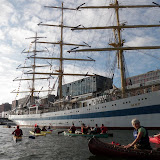
Bringing a salute to the tall ships of Sail on the Saturday morning has become a tradition, organised by the 3 kayakclubs of Amsterdam on every edition of Sail Amsterdam. This morning a group of 380 kayaks and canoes paddled along the imperessive Sail-fleet in the IJ harbour in Amsterdam, under escort of the water-police. I got up early to meet Natasha, Hanny, Nynke, Paul and Jan at 6 AM at the boathouse of KV Wyrda - the local kayakclub. We loaded 2 canoes and my Tahe Greenland-kayak on the clubtrailer and drove to Amsterdam: the kayak-salute was scheduled from 8.30 till 9.30 AM. After the coffee at the Amsterdam Marine Emplacement I said bye to my kayak-friends from Woerden and slipped back into the Greenland to paddle home to Woerden. Starting in the canals of Amsterdam, I paddled a long list of Dutch rivers and canals: Amstel, Bullewijk, Waver, Winkel, Vinkeveense Plassen, Ringvaart Polder Mijdrecht, Wilnisse Zuwe, Heinoomsvaart, Kromme Mijdrecht, Kamerikse Wetering, Grecht and Oude Rijn. A nice trip through the Green Heart of Holland: it's amazing how close the countryside is to the Dutch capital...
According to the GPS I paddled 47,1 km from the Marine Emplacement to Woerden. With the visit to the Tallships added, I paddled a total distance of about 60 kms today. It was the first time I paddled such a long distance in the Tahe Greenland and I never paddled such a long distance with a Greenland-stick. It felt good. More on that later!
Woerdy: the mascot of the local youth summer-activities
Back home from hiking, biking and climbing in the Alps. After 4 weeks of abstinence I felt the urgent need to go for a paddle and to check if it still works: the paddling thing. Well, I am not disappointed: I could keep up with Guus ;-), a little training for the longer distances would be fine though (next Saturday 65 paddling-kms on schedule..), the rolls still worked.
On the local water some changes: temperature of the water has risen (fine for rolling), the water has also got a bit smelly and green (not so fine for rolling, keep the mouth shut and nose and ear-plugs in...), and Woerdy has come.