Wednesday, September 10, 2008

Vlieland 2008 - The mystery track

picture of the day 4 - the mystery track.

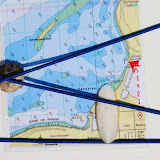
On the sand of Engelshoek we spotted a curious imprint. Some unknown marine mammal left the sand before we arrived. A more detailed view shows strange imprints every 30-40 cm on both sides of a longitudinal track of over 50 meters.

Quite sure it was a Grey Seal (Halichoerus grypus, meaning "hooked-nosed sea pig").

Tuesday, September 09, 2008

Vlieland 2008 - Heel-hook

Picture of the day 3 - by Axel Schoevers
In the morning one of the participants did a part of the assessment for NKB-sea kayak coach: " PvB 3.1. - het geven van een les" . A group of intermediate sea kayakpaddlers was introduced to the so called heel-hook- (or foot-hook) rescue.
The heel-hook is a method of re-entering the kayak where the swimmer pulls himself up the rear deck of his kayak by using his leg muscles. In order to do so, the swimmer hooks his heel (or foot) inside the cockpit right under the front deck (or under the thigh braces of a keyhole cockpit). In Dutch seakayak-courses mostly the X-rescue with a re-entry between the kayaks of the rescuer and the swimmer is practized. Advantage of the heel-hook re-entry is that it requires less upper body strength and flexibility.

Monday, September 08, 2008

Vlieland 2008 - Surf

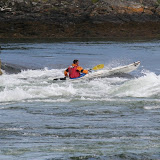
Picture of the day 2- Natasha and Marc

On this second day the Vlieland-week was blessed with a fierce Westerly wind blowing 6-7 Bft - Ideal for sweet surfing conditions. The advanced paddlers didn't make it around the sand of the Richel - again it was the second attempt - instead all had a good day in the breaking waves along the beaches of Vlieland.


I had a fine day too: on the water again! Because one of the coaches wasn't feeling well today, I replaced him and enjoyed coaching a mixed group of German and Dutch paddlers together with Piet. The international contacts Dutch-Spanish-German-Belgian make the day!

Sunday, September 07, 2008

Vlieland 2008 - Puppy seals

picture of the day 1- by Patrick Dousy

Introduction of new seakayakers to the sea - the full experience - feeling, tasting, touching white sand and salty water....

Vlieland - the first launch

Just an hour ago all groups launched from the beach of Vlieland - At this moment 7 groups, total 65 paddlers are on the water. Today I stay at the campsite to arrange some minor logistical issues. Weather is clouded, but dry. Wind is blowing 5 Bft from South. Our Spanish guests were impressed by the height of the dunes (all kayaks had to be carried from the campsite to the beach over a 15 meters high dune...) and are slowly getting used to find sand in all their gear...

Lorea launching...

Marifoonbericht - opgesteld: zondag 7 september 2008 11.39 uur
Waarschuwing voor de scheepvaart:
Vlissingen Zierikzee Hoek van Holland IJmuiden Texel Rottum Delfzijl Harlingen IJsselmeer Marken, zuidwest 6
Verwachting van 14:00 tot 02:00 uur:
Zierikzee Harlingen IJsselmeer Marken, zuid 4-5, eerst af en toe 6, spoedig ruimend zuidwest,buien, mogelijk met onweer,zicht goed, in neerslag matig

Saturday, September 06, 2008

Live from Vlieland

Thanks to my latest digital gadget I now have a connection from the remote Dutch isle of Vlieland to the World Wide Web. Which is very handy for regular weather updates, and also offers a unique occasion for live updates from the happenings on the NKB Vlieland sea kayak week.

Today wind was blowing from S-SW 5-6 Bft. Gales were predicted up to 7 Bft. In combination with the tide running late, we decided to make the crossing to Vlieland (35 km's) with the complete group by ferry - a quit relaxed start of the week. Looking down from the ferry at the water the waves looked very tempting, perfect conditions for a fast surfing ride to the isle... Thinking of the 65 kayaks on board of the ferry, I suppose it was a wise decision we made.

Atcampsite Stortemelk tents were pitched up. The ZVE (advaced sea proficiency) group of Joris prepared todays' evening meal under supervision of chief-cook Michel.

Evening menu: "rote Beete" soup with creme freche, Confit de Canard with roasted potatoes and rosemary and green asparagus, cucumber-salad with dill. (For the vegetarians a timbal from aubergines with goat-cheese piled up with basil). Dessert: Mango-sorbet with fresh blackberries and blackberries. A culinary traction for an international party on the tables Dutch, Spanish, German, French and Catalonian languages were spoken...
And tomorrow: time for paddling...

Friday, September 05, 2008

NKB Vlieland Seakayak Week 2008


A message for the participants of the Vlieland Seakayak Symposium - starting tomorrow:
-----------------------------------------------------------------------

Mededeling voor de deelnemers aan zeekamp Vlieland die morgen de oversteek Harlingen-Vlieland per kajak willen maken:

Beste deelnemers,

Het marifoonbericht, opgesteld vrijdag 5 september 2008 17.27 uur:

Verwachting voor zaterdag 6 september 8.00 tot 20.00 uur:

IJmuiden Texel Rottum
zuid 5-6 ruimend zuid tot zuidwest, toenemend 6-7,kans op een bui, mogelijk met onweer,zicht goed, in neerslag matig

Op basis van de verwachtingen heb ik in overleg met Joris besloten de oversteek per kajak van Harlingen naar Vlieland morgen in principe af te blazen. Alle weersvoorspellingen geven een vergelijkbaar beeld. Voor deelnemers in bezit van het certificaat ZVE maken we nog even een voorbehoud/uitzondering. Zij kunnen zich morgenochtend om 12.00 uur melden bij de Willemshaven. Ter plaatse en op basis van het op dat moment actuele weerbericht kan dan eventueel alsnog worden besloten met een kleine groep ZVE-ers de oversteek per kajak te maken. De kans dat dit gebeurt acht ik echter niet groot.
De veerboot vertrekt om 14.15. Reken op ruim 1,5 uur voor inpakken, inchecken, auto parkeren.
NB: de organisatie van de Vlielandweek beslist of er wel of niet per kajak wordt overgestoken.

Het is jammer voor morgen, maar we hebben daarna nog een hele week om te kajakken. Vanaf maandag neemt de wind af, komt de zon terug en stijgt de temperatuur!

Tot morgen!
Met vriendelijke groet,
Hans

----------------------------
When there is an occasion for it (internet-access?), I'll try to update this blog during the Seakayakweek, and maybe Axel does, see his kayakblog - Otherwise: see you next week again!
An impression of last years' edition of Zeekamp Vlieland: in the weblogarchive - september last year.

Thursday, September 04, 2008

19-21 september: It's party time! NKB 75 years

The Nederlandse Kano Bond exists 75 years in 2008. There is a party at the site of Dutch Water Dreams in Zoetermeer on September, the 20th. Besides a reception and a party there will be a lot of kayak-activities going on. The Dutch White-Water Championships also take place in this weekend. There are to many activities to list here - check it out on the NKB75-website. Just some highlights for seakayakers: Freya comes for a demo and rolling classes, Nico is present with the kayaks of Seakayaking UK and gives a clinic, Peter shows the SKIM-range. This happening is sure worth a visit, I would love to meet you at the weekend!

Tuesday, September 02, 2008

The discussion on kayak-cockpit-design continues...

Keyhole-cockpit of the Valley Qajariaq compared to the ocean-cockpit of the Valley Anas Acuta seakayak.

Last weekend Paul asked me for advise about choosing a new seakayak. High upon his wish-list was a roomy cockpit to get in and out comfortably. This reminded me of a discussion I had with René lately about some of my recent statements on kayak-cockpit-design in this weblog. I think it's a pity to have René's opinion hidden deep in the comment-section. So I quote some parts of our discussion:

René said…
....In my testreports I often ask for smaller cockpits and more perimeterlines (behind) the cockpit; but I am afraid the builders/designers listen first to "signals" from the paddlers asking for easy entrance in the cockpit.
Probably this has something to do with the way the modern, average seapaddler (worldwide) is paddling, avoiding the rough stuff. Probably the modern paddlers have problems with small cockpits because they are also less flexible, less trained and heavier. ;-)
Reading the Norwegian magazine "paddling" this weekend it struck me that they had a good article on surfing and tailorfitting the cockpit of a seakayak for surf conditions. The tailorfitting itself was perfect, just identically to what I am advising about this subject.
The only thing is: why only tailorfitting a kayak for surf?? The better handling with such an improved kayak gives so much more confidence and safety, that the "inconvenience(?)" of a smaller cockpit looks only like a very small price to me.

Hans said…
....About the kayak-cockpits: I love the small ocean-cockpits on my Pintail and Anas Acuta. Of course that's because I like the rough stuff and I am "very flexible, well trained and not heavy" ;-) Nevertheless there are also some kayaks on the market with excellent modern style roomy cockpits that offer perfect control - which have their advantages (in my opinion) also on safety - not only for the "less flexible, less trained and heavier paddlers" ;-).

René said…
...About the cockpits: you are right of course that there are big cockpits with excellent knee-grip. Still I regard the smaller, ocean cockpits as more reliable and practical because:
- Minimal risk for imploding sprayskirts. Of course there are very tight fitting skirts for big cockpits but these require quite a lot of force to close them which is unhandy when you are tired or want to close quickly
- Better view on maps on your cart-table.
- Less risk of dislocating your knees form there position under deck in heavy dumping waves or with laybacks.
- A small cockpit is easier for tailorfitting than a bigger cockpit: important when the fit is not perfect for yourself.
- More perimeter lines along the kayak. For a rescuer it’s easier to grip a rope instead of a slippery cockpit-rim during a x-rescue.
Of course the big cockpits offer much comfort (for instance entering under difficult conditions), but this still does not appeal to me comparing with the safe feeling an ocean cockpit gives to me. I guess that I have seen and experienced too much of the heavy stuff in my kayaking career, for just to trust a big cockpit.
I am serious saying that whenever I need to buy a kayak that has a big cockpit because it’s not available with an ocean cockpit, I am going to close the forward part, rebuilding the big cockpit to an ocean cockpit.
Of course this is a very personal point-of-view.

René gives some solid arguments for the ocean cockpit. I want to add once more, in defence of the keyhole cockpit: a smartly designed keyhole cockpit with good places tigh grips can offer perfect boat control - and there are conditions when an easy and fast access or exit is a safety issue. I have no hesitations in advising someone to go for the keyhole. I even dare to say that most seakayakers are probably better of with a keyhole-cockpit! Especially for the large group of new seakayakers a far way over 50 years old - and I know it's risky to say this, but - you probably buy a new kayak to use it for a long time, perhaps 10 years or more ? - the chance you get more flexible isn't very big...

Personally to this "propagandist of the keyhole-cockpit" ;-) : the latest two seakayaks I bought are outfitted with an ocean-style cockpit... Which was a deliberate decision that I don't regret!

PS: add it to the list of important arguments: a small cockpit looks so sexy on a sleek long kayak!

Lifting the knees: try it with an ocean cockpit!

Taking a nap in a keyhole - cockpit: forget it with the ocean cockpit?

Ok: with some flexibility you can do the same in an ocean-cockpit.

Monday, September 01, 2008

The first salt water experience - part 2

This Sunday the second part of the "Grootwatertocht" from Kayakclub Wyrda took place. Due to some changes in participants, for most it wasn't actually the first trip on salt water but more a kind of a renewed acquaintance. For Jelle however, it was the first time to paddle out at the North Sea.
The day couldn't be more perfect. Sunny, air temperature 25 degrees Celsius, water temperature 19 degrees Celsius, Wind 2-3 Bft. SE. The sea offered highlight after highlight.

1. A close encounter with a curious seal. (Click on the picture for a closer look at the seal behind Jelle's kayak.

2. Mediterranean conditions during the break on a slowly under the rising water disappearing sand some km's before the coastline of Schouwen.

3. Some nice waves to play in. The perfect size to get the feeling for balancing and bracing.

4. And finally the feeling of gliding over a mirror, lost in space.
Wyrda grootwater08 deel 2
Click on the miniature for more pictures.

Paddled distance: 22 kms. Planning this trip I anticipated on the new rules for the Voordelta and avoided paddling in the parts of the Voordelta that will be closed in the future. We didn't land on the sand of the "Aardappelenbult" but on a sand near the "Schaar van Renesse" close to the isle of Schouwen. There were no seals or larger groups of birds resting on this sand.

Sunday, August 31, 2008

Jörgen has made it to Moldova!


At Wednesday the 27th August Jörgen Cobber van der Pol arrived in Chisinau, Moldavia. Jörgen started his "smiles for Moldava" kayaktrek on April the 5th. in Groningen. He paddled solo over 4000 km's across Europe since and has gone through a lot of adventures.
Jörgen: congratulated with this fabulous achievement!

Jörgen has written a diary of his adventures in Volkskrantreizen (in Dutch).
"Smiles for Moldava" is a fund raising action for maxillofacial prosthetics in Moldavia.

Sunday, August 24, 2008

The first salt water experience

Once a year kayakclub Wyrda offers the so called “Grootwaterkennismakingstocht“. This activity is aimed at kayakers new to seakayaking. It's a kind of a mini-course, split in two days: on the first day basic paddling and safety skills are practiced on open water – in preparation of the second day (a week later) on which a trip on the North Sea is programmed.

The “Grootwaterkennismakingstocht” is a rewarding activity to organize with enthusiast people enjoying the first time out at sea. Today I was leading the first day of the course, assisted by Patrick from kayakclub Natsec, on the Grevelingen. The Grevelingen is the largest salt-water lake of western Europe. It’s separated from the North Sea by the Brouwersdam – it’s a non tidal water with the salty taste of the sea – a perfect spot to introduce people to paddling on a large stretch of open water.

The challenge in organizing an activity like this is to keep it “low-level”. It’s often said that “a beginner in seakayaking isn’t a beginner in kayaking” (this quote used to be on the NKB-website, I understand why, but also think there are some arguments against it..) – but this activity should also be manageable for beginners in kayaking. A calm sea state is a condition. The weather forecast for the day (wind SW 4-5, increasing to 5-6 Bft.) wasn’t to promising in this respect. Some participants were a bit a worried about this foresight, yet I assured they would have an nice day… The covered distance wasn’t important, nor was speed or timing: just paddling in a comfortable pace, doing exercises every once in a while, relieved by rest stops on the water and an extensive lunch break made it a good day for all. But I can’t help: paddling against the wind is fatiguing! Which is good experience to get familiar with seakayaking of course ;-)

For Jelle it was the first time paddling on salt water. I had a great time watching my 14 year old son enjoying the waves: Jelle had never done this before, but he loved pounding against the wind and he tried to catch every surf with a following wind. Maybe a bit frustrating for the other (20-40 years older) participants to watch how easily a teenager learns. I was impressed by his suppleness – and by his power: it won’t take long before he paddles me out. I can hardly catch up now…
Wyrda grootwatertocht

Sunday, August 17, 2008

Olympic Games - Dutch pride

Some deceptions with swimming, but the Dutch athletes were very successful in the water sports disciplines this weekend: Gold and Silver in rowing (double sculls Women, eights women), Silver in sailing (Yingling women). And the Dutch slalom kayakers also performed outstanding: Ariane Herde and Robert Bouten both made it to the finals!

Update 18-08-08:
The Olympic games are a good excuse for some (harmless) chauvinism and nationalism ;-) This morning the Dutch success- story continued with another Silver medal in sailing (470 women) and Gold in cycling (Marianne Vos won the cycling points race). Dutch women are very strong!

Saturday, August 16, 2008

Beheerplan Voordelta - new rules for seakayaking

Over the past two years I have regularly written about the upcoming new rules for human activities in the Voordelta and the consequences of these rules for seakayaking in this popular stretch of the North-sea coast (near the isles of the Dutch provinces Zuid-Holland and Zeeland).
Some previous post on this topic:
Some weeks ago the authorities have published the final decree: het Beheerplan Voordelta. On the dedicated website of Rijkswaterstaat you can find all the official documents. The last decree is still open for appellate review and on some preliminary decisions the procedures in court aren't finished yet - nevertheless: legally the new rules are already in force. In the next months information signs will be placed on location and the closed zones will be marked by buoys.

The kayak relevant parts of the final decree are unchanged in relation to the drafts I referred to before. The new rules result from a good and intense contact between the authorities and the Dutch kayak-associations. It's a fact that freedom of movement for seakayakers in the Voordelta is reduced. But I do emphasize that the interests of the kayakers have really been taken in account and that the new rules still offer attractive opportunities for seakayaking-activities in the magnificent nature reserve of the Voordelta.

Wednesday, August 13, 2008

Polar times in The Hague


It's a good Dutch museum-season for people interested in polar (wild)life and Inuit culture. In Leiden the exposition "The big thaw" is still running (when you haven't visited "The big thaw" yet: hurry - it's in the last month). And in July the Museon in the Hague opened a new furnished Polar exposition room as part of its permanent exposition.
The Museon is the former "Municipal museum for education" in the Hague. Since the mid eighties it has become a popular scientific museum with a huge collection, covering subjects from geology, biology & environmental science, history & archaeology, physics & technology to cultural anthropology. The Museon has a lot of Inuit objects from Greenland, acquired by Nico Tinbergen around 1930. The new Polar room isn't very big, but attractive: a modern tasteful designed interactive multimedia presentation. For kayak enthusiasts: exposed are two kayaks from Greenland. A small kid-sized one (with a mini Greenland-paddle and a cute little harpoon), and a very old greenland one decorated with Dutch West-Frisian (Hindelopen) paintwork. The latter is a bizarre object - some hybrid of Greenlandic and Dutch culture: in the 17th century Dutch whale hunters brought the kayak to the Netherlands and an anonymous painter decorated it in the 18th century with Dutch folk art. Presented are also some kayak-models, clothing and other hunting gear and there are also 2 videos about kayaking and hunting with a kayak.


Walking back to the station we discovered a giant iceberg floating in the Hofvijver, next tot the Netherlands Houses of Parliament. We first thought it would be part of some climate campaign of a NGO. But the object turned to be part of the exhibition The Hague Sculpture.


Nearby at the Buitenhof is a giant sandsculpture to be found. It's made two months ago. Sun and rain have eroded the sculpture since, but it's still amazing intact. Against the background of the skyline of The Hague in some scenes the theme ‘Den Haag, City of Peace and Justice’ is presented. The Skyline is a compilation of the known historical buildings in The Hague, complemented by the modern architecture of the (partly yet to build) new centre. Prominent in the foreground is the Peace Palace, as an international symbol of the City of Peace and Justice. End of august the remains - a mountain of sand - will be removed from the Buitenhof.

Sunday, August 10, 2008

Parlez-vous français? ... Espagnol?

Baccara was a female vocal duo, formed in the mid 70's by two Spanish flamenco artists. The duo peaked at the music charts with their debut single "Yes Sir, I can boogie", soon succeeded by another cult-classic: "Sorry, I am a lady". The combination of English with a strong Spanish accent, a blend of pop, disco and Spanish folk, performed by two charming ladies was a big hit all over Europe. In 1978 Baccara represented Luxembourg at the Eurovision Song Contest with "Parlez-vous français?". Broken French with a Spanish accent was too much for the Dutch - no points for Luxembourg and after the songfestival Baccara was soon forgotten in the Netherlands. In Germany and some other neighbour-countries the story went on, and after a split up incarnations of Baccara appeared into the 90's.

The latin charms of Mayté and Maria appealed to me as young teenager - the album from Baccara was one of the first "LP's" I bought from my own money. The album still is in my - neatly alphabetical organised - vinyl collection: Baccara between the "Satchmo Serenades" from Louis Armstrong and "The Last Waltz" from the Band. Over 300 vinyl records only collecting dust, but I can't say them farewell...

Sorry, I digress. Why this little confession in this personal but mainly seakayaking-related weblog? The explanation comes in two steps. The first step is that I just returned from Paris. I have been biking with partner and kids from Woerden to Paris (click here for the picture album). I enjoyed the holiday in France, but "Parlez-vous francais?" -> communication in French is quit difficult for me, alas. I manage, that's all, and I really do regret I didn't put more effort in learning French in my schooldays...
The second step is that I am busy with the preparations for the Vlieland Seakayak-week of the NKB in September. The NKB-courses are getting more and more international: this year we also welcome Spanish participants. As I heard of the Spanish interest in participating in our seakayak-courses I was immediately very enthusiast about the idea, but a bit worried about the communication. Our seakayak-coaches don't speak Spanish and the Spanish participants don't speak Dutch (nor German, nor English). The solution turned out to speak French: the Spanish participants are said to speak French
fluently - and so does one of our Seakayak-coaches.
Back to Baccara: when the Spanish kayakers speak French like
Mayté and Maria - even I must be able to understand ;-) !

Monday, July 21, 2008

Something completely different...

The kayaks are swapped for bikes and internet access will be scarce - therefore it's going to be a bit quiet on this kayakblog the next weeks. In the middle of August I'll be back on the water again! See you!

Have a nice summer with a lot of paddling,
greetings,
Hans

Saturday, July 19, 2008

Ariane ready for the Olympics


Arian Herde and Robert Bouten are the two Dutch Slalom-kayakers qualified for the Olympic-games in Peking. Watch Arianes' final fitness-test in this video of Volkskrant-TV. Test and video shots taken on the DWD-WW-track in Zoetermeer.

Thursday, July 17, 2008

Scotland journey 5 - final: Lismore and Shuna Island


Early morning atmosphere in Loch Linnhe.

After visiting the Falls of Lora Govert and I had done all the highlights we planned. We were so lucky to have 2 more days left over and felt like another kayak-camping trip. Circumnavigating the Isles of Lismore and Shuna in Loch Linnhe was a fitting option. Starting point was the Pierhouse hotel at Port Appin - a perfect place to embark: with a easy accessible pebble beach direct in front of the car parking and the comfort of a good restaurant at start and finish of the trip (note: there is not much parking place in Port Appin, I won't advise it at busy days!).

Thursday was the first and only day during our Scotland-journey that it was clouded, raining an drizzling all day long. Yet it wasn't an unpleasant day - actually the drizzling atmosphere made the experience of the impressive scenery of Loch Linnhe, surrounded by the Scottish Mountains even more intense. Porpoises and seals accompanied us on our paddle. We headed from Port Appin south to Lismore Lighthouse where we had planned the first stop. Arriving at Lismore point however, it wasn't to appealing to get out there in the rain. The next few places to land (which are rather scarce at low tide) were all occupied by seals or seabirds we didn't want to disturb. Finally we paddled over 30 km's before we got out of the kayaks for an extensive break. Cooking water (Tea (Hans, Coffee (Govert))took a bit longer because the MSR-Whisperlite cooker needed an in the field repair. Sometimes these cookers refuse to work properly for some vague reason, but after repeated disassembly and assembly they always recover in the end.

After the break it was just 10 more kilometres to the Northern tip of Lismore, where we camped between the sheep. The next morning was fantastic - it had stopped raining, and while the clouds slowly disappeared, the impressive Scottish mountains around the mirror like Loch Linnhe appeared. Shuna is only a little isle - so there was no reason to hurry. Between Shuna and Port Appin lies the picturesque site of Castle Stalker. We arrived at the Pierhouse hotel before lunchtime. The hotel-manager welcomed us friendly in Dutch. It turned out she had worked in Leiden in the Netherlands in younger years. After unloading the kayaks, packing the car and changing clothes we celebrated the end of a fantastic journey with fresh seafood in the Pierhouse Hotel. Scotland has made a marvellous impression - we are devoted!

Lismore- Shuna

Click on the Picasa miniature for more pictures of Shuna and Lismore.

Thursday 5th June, 38 km, Port Appin - circumnavigating Lismore - no wind, rainy
Friday 6th June, 12 km, Lismore - Shuna Island - Port Appin - no wind

Scotland journey - 4: survival paddling in the Falls of Lora

It's about time to finish the series of reports of the Scotland-journey: meanwhile Scotland more than a month ago and the next vacation is coming in a few days... So here are the reports of the last two stages: first our morning-paddle in the Falls of Lora (Click on the link for detailed information about this marvellous playspot). Twice a day ebb and flood press the water of Loch Etive through the narrows under the Connel Bridge near Oban. At spring tides the tidal range is around 4 meters and roughly 45,000,000 cubic meters is finding it's way out. That's a lot of water with tremendous power.


The video of Nicampbell on Youtube shows more than words can. In Justine Curgenvens' video "This is the sea 3" you can admire some skilled seakayakers surfing on the Falls of Lora (the first shots of the TITS3-trailer are taken on the Falls of Lora, Axels' quote about his "wetted pants" refers to his wet exit in the falls). With this in mind the Falls of Lora were a must-do for us.
We timed the best ebb spring tide and went for it. It was absolutely awesome: the first two hours when the tide was full running. To be fair it was more "survival paddling" than "playing with the waves", but what a fun it was, surfing, bracing, rolling! It was a completely different experience than I am used to paddling in surf at sea. The water is salt and the sea is the scenery, but actually it's more white water-river paddling than seakayaking. Of the experiences I had in my kayaking career paddling the Dutch Water Dreams-track comes closest to it.
Govert is the more experienced WW-kayaker of the two of us. He dealt amazingly well with his Dawntrader-seakayak, but he swam also a bit more than I - because he pushed it more to the limit than I did. That's what a "re-entry and roll-self rescue" is good for... And thanks to Justines' video we know that we needn't to be ashamed with our wet-exits: when even Axel and Freya do -> we are in good company ;-) Nevertheless we both decided to pick up ww-kayaking and to make an appointment for the DWD-track this summer. There was nobody to take pictures or to film of our adventures in the Falls of Lora - I only managed to make some shots at the more tranquil moments. The Falls of Lora truly deserve the titel of seakayakers' Nirvana!
Falls of Lora

Wednesday, July 16, 2008

Monty Python and the Holy Grail - Castle Aaaaarrrrrrggghhh


King Arthur and Sir Lancelot the Brave in the final scene of Monthy Python and the Holy Grail, Python Pictures Ltd, 1974

Yesterday I watched the DVD of Monty Python and the Holy Grail together with the kids. It's fascinating to notice that the 35 years old humour of Monty Python still appeals to modern teenagers. I had a great evening too, enjoying all time classics like discussions of coconuts and swallows, a black knight losing limbs, the knights who say Ni, the killer rabbit and the other great scenes. At the end of the film Castle Aaaaarrrrrrggghhh looked suddenly very familiar: I recognized Castle Stalker near Fort Appin. Govert and I passed the picturesque castle in Loch Linnhe on the last day of our Scotland kayak-journey - at that moment not realizing to be paddling in the footsteps of Arthur and Lancelot, so close to the Holy Grail ;-)


Govert and Hans in the final stage of the Scotland-kayaktrip, Govert Plugge/Hans Heupink, 2008.

Sunday, July 13, 2008

The surfspot on the "Bollen van de Ooster" aka "de Aardappelenbult"

No action pictures today because my beloved old Sony DSC-U60 underwatercamera refused to do its job. I am afraid it's getting time for a new water proof digital camera. Alas Sony doesn't produce a worthy successor, and I am not very impressed by the waterproof cameras of the other brands. Perhaps the new Pentax W60 - has anyone already tried this camera?

Wind was no more than force 3-4 Bft today, but after a week of westerly winds up to 5-6 Bft surf was good above the "Bollen van de Ooster" (also known as "de Aardappelenbult") a huge sandbank in the North sea, some miles west of Goeree. Nice about this spot is that you can approach it sheltered in the lee site and decide how far you want to go into the rough stuff.

Today I was here with 2 experienced (level 5 star) seakayakers. We arrived at the Aardappelenbult at high tide, the water level was about 1 meter above the sand. The waves coming from the North sea turned into surf over the sand, creating a hundreds of meters wide surf zone over a length of kilometres in the middle of the sea - a perfect play spot to train surfing and bracing skills. It's a long time ago I have had the conditions so good here. We had wonderful long rides over breaking waves, the GPS recorded speeds up to 2o kmh. It was the first time I paddled the
Anas Acuta in surfing conditions (I mostly paddle the Pintail at seatrips) and its performance was outstanding - it tracks good - no skeg needed, it's very responsive to edging and it's very manoeuvrable.

Some breaking waves were a bit awkward and one of the kayakers had wet exits in the surf zone. No problem - it's a quit safe spot. (It might take some time, but the water flows over the sand and brings the swimmer in calmer waters. The weather was fine: sunny, 20 degrees Celsius, water-temperature 18 degrees Celsius) - anyhow, a good occasion to train rescue skills in lively water. Towing a kayak with swimmer out of the surf zone is hard work, emptying a kayak in moving water in a x-rescue also. A note regarding kayak lay-out: a large cockpit design makes climbing in easier, but a high foredeck takes a lot of water when the kayak is turned over. Kayaks with large cockpits and a dayhatch often lack good decklines to grab direct in front and behind the cockpit (which makes handling the kayak and stabilizing the raft more difficult). The kayak in question was a Point65 XP, but the missing decklines over a big distance near the cockpit zone is something typical for more recent kayak-designs.

At the end of this summer recreation around the Bollen van de Ooster will become
more regulated. The complete sand will be a closed zone, even when it's flooded at high tide, and also for kayakers. There is one exception - exclusively for kayakers and windsurfers is a zone reserved at the most North-easterly tip of the "Bollen van de Ooster" (the area with the diagonal lines on the map -see below). We explored this zone today. It's a spot with good surfing conditions around high tide. I just wonder how the boundary to the closed zone will be marked: on the water you don't see any difference - it's just surf for kilometres...

Friday, July 04, 2008

Corryvreckan, Grey Dogs, Falls of Lora


Today I updated the 3rd report of the Scotland seakayak holiday. For readers that are interested in more background-information about the famous Scottish tidal races I referred to, useful weblinks are :
- The Falls of Lora Information Website by Tony Hammock;
- The Corryvreckan Whirlpool by Mike Murray - Corryvreckan Whirlpool Guide;
- Pictures of the Grey Dogs tidal race by David Philip;
- and don't forget the Seakayakphoto-weblog of Douglas Wilcox (search for the tagged items with Corryvreckan or Grey dogs)
Alas I can't cover this part of our journey with good own pictures. On these part of the trip both hands on the paddle were welcome ;-). And when I took the camera out, it immediately got wet, so the shots of the best action-moments are blurred and unsharp because of nasty drops on the lens.

For an action video of seakayaking in the Scottish tidal races: Justine Curgenven's DVD "This is the sea - part 3" covers the Falls of Lora and the Grey Dogs (click here for a preview - with a striking quote of Axel about what the Falls of Lora did to him ;-).

I suppose a "disclaimer" (or call it a little warning) is fitting here. You really can have fun with a seakayak in these places. And Govert and I did have a lot of fun! We had the unique experience of playing in the Grey Dogs with tide full running, paddling the boiling-pot and the eddy lines of the Corryvreckan 2 hours before slack water and were fighting the Falls of Lora at spring tide. We found this manageable -with 30 years of seakayaking and WW-experience together, but both without real local knowledge- but do realise we had the luck of relative calm conditions (no swell from the Atlantic and hardly any wind). And even so - these are serious and potentially dangerous waters that should always be dealt with respect! To paddle here you should be very experienced in handling rough water, be well equipped and know what to do in the case of an emergency. If you have any doubt about paddling here - be sensible and turn back. The wisest way to find your way here is to take a guide. In Oban you can find some experienced seakayak-coaches with a lot of local knowledge: ask them to take you out!

Wednesday, July 02, 2008

Modern kayak cockpit design - rolling the Tsunami120

Recently some enthusiast new members joined local kayakclub KV Wyrda. Together they form a group that is eager to learn - a pleasure to work with! Yesterday-evening I found myself teaching basic kayak-"control and safety"-skills to Maxime, Hetty, Nienke and Natascha in Reeuwijk. It was a fun and wet session: the water is warm and the weather is fine. All had a good laugh. The ladies were paddling the new club kayaks - type Wilderness Systems Tsunami 120. KV Wyrda expanded the fleet with these boats last month, to offer beginners a comfortable and stable, confidence-giving kayak to get into the sport.

I never paddled the Tsunami120 and actually only knew the boat from the pictures on the web. The beginners in the club have been paddling the Tsunamis for some weeks now. I was told that most like this boat because it's stable, comfortable and tracking well (on the placid waters around Woerden). Some of the beginners however, prefer the older club-kayaks because they are faster and paddle more effortless. Because the (PE-)Tsunami are more robust than the other club-kayaks and because I didn't plan to cover long distances with the group anyhow, I asked yesterday to take the Tsunamis to Reeuwijk.

At the end of the session I changed kayak with Nienke - It's important for a coach to place himself in the position of his pupils (in sport also physical) to understand what the pupil is feeling. It's fine to demonstrate kayak skills in the trusty seakayak, but does it work in a recreational-boat? I wanted to experience myself what the Tsunami feels like. Is this boat suited to learn leaning and edging? And in next lessons: for bracing and rolling? To be honest: my expectations weren't very high. The Tsunami is a short, wide kayak with a high deck and a padded seat with backrest that looks like an armchair. Perhaps the perfect boat for kayak-fishing or sunbathing, but not the first design that comes in my mind when I think about a kayak to learn people an active kayak-technique. As I slid in the kayak I noticed that I had underestimated the Tsunami seriously. The outfitting of the kayak invites to an active seating position and gives good support. It's easy to edge, it responds well and to my biggest surprise: it's unbelievable easy to roll. I was impressed in the five minutes I was paddling and rolling the Tsunami! This morning I went back to the clubhouse for a closer look and an ample rolling session.

The Tsunami is the "living proof" that a seating position with good contact/control is far more important than finesses in hull design. Despite the wider and flatter hull the Tsunami rolls easier than many (older) sea- ww- and greenlandkayak I paddled before. I am sure this is due to the modern ergonomic cockpit design that is incorporated in the Tsunami. Characteristics of this design are primary a wide and high position of the knees, combined with a low seat and well contoured thigh grips. The roomy seat brings also some advantage in rolling - some space to shift side to side is good. This "knees wide and high"-design has become standard in modern WW- and rodeo-kayaks - and is also getting more common in seakayaks: examples are the NDK Romany, the Explorer HV and the Rockpool Alaw - kayaks with a seating position that comes close to this principles . It's no coincidence that all these boats are known as good rollers (btw: there are surely more recent seakayaks with a similar cockpit design - these are such boats I know from personal experience...). It's a totally other philosophy than that behind the design of Greenland rolling kayaks (low deck, stretched legs, padded Masik (deck beam), snug fit).
The Greenland design is proven, for over thousand years. It's good - I won't detract from that. The "knees high and wide"-idea is perhaps ten years old. It shows that there is always potential in development -WW and rodeo ideas contribute to modern seakayaking.

It was fun Greenland rolling in the Tsunami. Looking at the pictures, you might think the high backrest hinders with layback rolls, but it doesn't: the backrest has a recline feature and tilts backwards when you lean on it. Forward endings rolls are no issue. The only downside with the clubkayaks is the miserable nylon sprayskirt. The sprayskirt looks tough, but gets loose every time you roll. So you end up rolling with an open cockpit full of water.