Monday, March 26, 2007

Cold? 2 - No more - the Palm Sidewinder Drysuit


The idea behind blogging is uncomplicated direct publishing, resulting in short and quick reports, with no delays. It used to work for me this way, but lately I am afflicted by an increasing number of unfinished drafts of posts. Tired after work or spending the evening with all either kind of (often seakayak related) buzz.. Grrrr… The following post on the drysuit is one of the long time unfinished ones. As I am publishing it, “winter” (what winter?) is definitely over, sun is back and temperatures are getting really pleasant. So: posting now about a drysuit, a piece of winter gear? Isn’t that a bit late? At least the participants of the NKB-coldwatertraining know better! As a matter of fact the coming period is from the view of hypothermia the most dangerous of the whole year: with the warm air temperature it is tempting to paddle lightly dressed, but the water is still very cold…

After a period of doubt, a year ago I decided to buy a drysuit. In the Dutch touring and seakayaking scene drysuits are not very common, most kayakers wear neoprene wetsuits in combination with anoraks, also in winter. So did I. But soon the Drysuit became one of my absolute favourite pieces of gear. It’s comfortable, it’s practical, it’s ideal! I’ve used it intensively on all kinds of kayak activities: on shallow waters around Woerden touring and training with the local kayak-club, on single and multiple-day seakayak-tours in spring and winter, during severe white water runs (ending up “swimming” in WW-IV…), endless rolling sessions, coaching surf classes (which means standing hours in the water) in late autumn, and so on. It’s a incredible versatile piece of kit. It opens totally new dimensions to kayaking: no fear for outdoor rolling sessions in winter! One of the highlights was floating like Bibendum in cold water surrounded by ice…

The Drysuit is a Palm Sidewinder Classic. It’s the basic version of the Sidewinder Torrent about which Erling has written an extensive review in the UKseakayakguidebook. The reason why I preferred the basic version:
- The Classic has the entry zipper over the shoulder, the Torrent has the zipper on the back. I find the zipper over the shoulder better reachable and easier to operate without help;
- The Torrent offers sewn-on booties. Sure dry feet are more comfortable, but I am worried about the vulnerability: my experiences with Goretex socks and shoes are not good. So I prefer latex cuffs on the legs…
- The Classic is about 50 euro’s cheaper (I agree: a very Dutch argument!)
Other differences between the Classic and the Torrent:
- The Torrent offers a separate Relief Zipper, the Classic not. But the zipper of the Classic opens so deep you don’t need one! (Presuming you are (1) male and (2) a bit flexible).
- The Torrent offers a double waist seal system for the sprayskirt. That’s a nice future, I would really have liked it. But with a tight fitting neoprene spray skirt leakage of water in the cockpit is limited and in a drysuit you don’t mind a few drops of water in the cockpit.

In the kayakshop I choose this real British design of a renown British kayak outfitter, so I was a bit disappointed when I discovered (back at home..) a label “Made in China”. That’s globalisation… Perhaps I should be happy with that. I am not quit sure if the Drysuit would have had the same built quality when it was made in Brittain. It’s a complex construction with a lot of different panels, used materials (a mix of Palm XP 150 and Cordura fabrics, Neoprene cuffs, latex seals, Velcro adjusters, Zippers and so on). The finish is perfect, the Chinese have shown real craftsmanship! After a year of intense use it still doesn’t show any sign of wear. All seams are still waterproof.

Some practical experiences:
- With a warm core, uncovered extremities are also less sensitive for cold: hands and feet keep longer warm. Paddling in neoprene I always had to use gloves or poggies in winter: now It can be much colder before I feel the need…
- Don’t expect miracles of the breathability of a drysuit. I think the Palm XP 150 material performs well in this aspect, but with the lower part of your body locked in a closed kayak cockpit and the upper part for 80 % covered with a Pfd there is hardly any way for humidity to get out… After some hours paddling clothing you wear under the drysuit get damp. But with technical underwear and a layer of thin fleece that’s no big problem. Just bring along an extra set fleece on a multiple day trip.
- Once or twice I had some water-leakage along the latex cuffs: my fault with inaccurate dressing up, resulting in the end of the sleeves of the fleece shirt trapped in the latex seals.
The “minor points”:
- For real sporty kayak-sessions the combination of a drysuit with fleece underwear is (to) hot. For touring it’s ideal. Just stay paddling on the “below sweat-zone level”. And when the sun really comes back drysuit-time is over. (Last year that lasted until June!).
- On multiple day-trips with the chance of changing temperatures the drysuit option lacks flexibility…

Sunday, March 25, 2007

Respect


Respect. That's what comes in my mind after the second session on the DWD course this morning. Respect for the power of the water, respect for the control of the WW-coaches on the water. After two succesfull runs on the white water track during the first session, I had good hopes about the second session. But this turned out to be a lesson in modesty. I swam a lot today. Look at the clip of the training session of David Florence on the DWD-course. David makes the track look like a piece of cake. With a single bladed paddle. I can only have great admiration for a performance like this...

And now something completely different: In the afternoon Lieke and I visited the finish of the first edition of the Pro-tour de Ronde van het Groene Hart here in Woerden: 1. Wouter Weijlandt (Be), 2. Graeme Brown (Aus), 3. Gerg van Avermaat (Be). 203 km in 4.23 hours. Great admiration for this performance too; a hard course on a windy day. For a distance like this, I need a day, these guys do it in the afternoon... Respect!
It reminded me of an earlier lesson in modesty I had about 10 years ago, when I attended a cycling trainingweek in Mallorca. On the first day of this week I joined the training of the group of elite racers -> a level below the pro's. A big mistake: I learned there is a world of difference between a racer and a tourer in the cycling-world. I have never been so exhausted as I was after that day...


Saturday, March 24, 2007

Cold? 1 - NKB Koudwatertraining


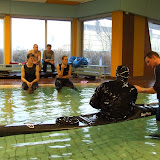
Both pictures of floating kayakers in and on the water are taken during the Coldwatertraining organised by Pieter de Haas last week for the NKB Seakayak-program. Despite the sunny images, it was a cold day (Water temp 5 degrees Celsius, Air temp 10 degrees Celsius) with a chilling wind (6 Bft). Perfect conditions to experience the effects of hypothermia. Pieter, Arie and Sien reported me about this event. I couldn't attent myself -> you can't have it all!

The Coldwatertraining began with an extensive lecture of Watze de Vries on "everything you should know about Hypothermia". Afterwards the participants were encouraged to experience the impact of cold water themselves under save and intensively monitored conditions.
For most participants it was an absolute eye-opener how fast hypothermia develops. Some guys thought they were well dressed up! The participants used a wide range of different kayak-outfits: only technical underwear under an anorak, fleece gear, aquashell, chilcheeter, neoprene long johns with anoraks or drytops, drysuits etcetera. After 5 minutes some kayakers couldn't grip anything anymore with their hands, after 12 minutes - just before real hypothermia occurred - the test was stopped. Some swimmers needed more than an hour to warm up... The superior outfits proved to be drysuits (with a warm fleece underlayer) and the extra thick neoprene longjohns in combination with fleece and a drytop. A warm covered head als o made the difference. For many neoprene long-john users (the most common outfit under Dutch seakayakers) cold arms were the weak spot.
Everybody was enthusiast about this initiative of Pieter. It was found highly instructive. As a result we have got lots of requests to do this every year. Some even said an event like this it should be a standard part of the NKB-schooling-program. Thanks to Pieter and Watze for organising this perfect day! It was great to be able to use the facilities of Zeil en Surfcentrum Brouwersdam Let's give it a follow up!

Going to extremes: in the papers this week was an advertisement showing "the Ice Man", Wim Hof preparing for a new expedition to Mount Everest - he intends to climb the mountain in his underwear. Wim Hof is sponsored by a producer of refrigerators... Wim has been swimming naked under pole ice, ran a marathon in Finland without shoes and climbed snowy mountains in his shorts. All activities in the category "don't do this at home". It's not a trick, it's a kind of dealing with cold and hypothermia that's given few of us. You can argue how wise an approach like this is, better prepare and prevent! But Wim shows us that dealing with cold has also a mental aspect....


A more sensible article on hypothermia, with special attention for open water sports is on the site of the American Canoe Association (thanks to Bonnie for this link!)

Wednesday, March 21, 2007

Springtime!


At 00.07 CET last night the sun could be observed to be directly above the earth's equator. In astronomy this is called an equinox, it marks the beginning of astronomically spring on the Northern hemisphere. And that was just about time. Let's forget the winter we didn't have. With 6.5 degrees Celsius average it was the warmest winter ever measured in the Netherlands. A warm and also very wet and gloomy winter; lots of clouded days and hardly any sunshine (157 hours against 172 hours on an average Dutch Winter). It was so dark the battery power indicator of my solar powered watch turned on low level last month. That never happened before...

Meteorological spring starts 1 March. It made a good start with some really pleasant sunny days, soon the watch was back on high power-level again. The picture above was taken last Friday: the falling barometric pressure graphic predicted the deteriorating weather period we are in now. It's a little miracle this "watch": timekeeping, compass, barometer, thermometer, altimeter, world time, countdown timer, stopwatch, alarm... It all works with great accuracy. A nice toy, but to be honest: nowadays the added value of the private weather forecast based on local changes in air pressure is limited, since you have (even on a multiple day seakayak-tour) continuously access to professional wind- and weather-forecasts by Radio, GSM, VHF and internet...

It's not in the manual, but I discovered an other great feature of the watch: the power-indicator functions as a personal "Seasonal Affective Disorder Depression (SAD)-indicator", when it turns low it's time to get out that dull and dark office and to go out kayaking, to prevent the winter-depression... Pfff, hope real spring comes soon ;-)

Tuesday, March 20, 2007

Dutch White Water...


Finally we have got some white water over here, And it's great!!! Next sunday is the second session of the NKB-DWD-Try out. Maarten sent these pictures of the first session.

Sunday, March 18, 2007

This is the sea 3


Yesterday at the premiere in Zaltbommel Axel and Nico offered a first impression of This the sea 3 (TITS 3). I watched the full two hours(!)of the DVD this morning. Now I am even more impressed. The DVD offers a fascinating mixture of travel reports and a series of interviews with special personalities of the seakayak-world, often in a great scenery with impressive wildlife. And Dutch seakayakers are well represented by Axel. After watching this DVD you just want to go out with your kayak. I can't wait to paddle myself in the tidal races of Anglesey in June. But this afternoon it's swimming pool-time again: indoor excercises with Kayakclub Wyrda. Let's try rolling like Freya and Cheri!

The trailer of TITS 3 in this post is some kind of premiere on its own. The first moving pictures in my blog! It took a long time, but finally I figured out how to add a video. It's surprisingly simple with You Tube. Next step -when I learn how to upload videos to You Tube- are my own videos. The world must be waiting for rolling videos from Woerden ;-)

Of course all credits of the trailer are for Justine Curgenven. You can order a copy of TITS 3 directly from Justine over her website www.cackletv.com, Justine delivers worldwide and fast. For Dutch enthusiasts: Axel and Nico sold out all the Dutch copies at the premiere yesterday, but Axel is on his way to Wales. Axel returns at the end of next week with a new supply of TITS 3 DVDs. Contact Axel or Nico for orders.

TITS3 - premiére in the Netherlands

picture by Patrick Dousi

It's said before: in the Netherlands everything happens 50 years later than in the rest of the world. But we are catching up at high speed. Yesterday-evening we had the Dutch premiere of This is the Sea 3. That's only 4 days later than the world premiere and launch party at Canoecopia in the States!
Thanks to Axel and Nico for organising this nice event in the swimming pool of Zaltbommel. In the afternoon everybody got the chance to try out the complete collection of NDK-kayaks, in the evening the DVD was shown on big screen. I enjoyed the day together with a big group of Dutch seakayakers that came from all edges of the country to watch Christine Curgenven's DVD: a must have!

In the pool I coached different kayakers with rolling exercises. And tried out the NDK boats myself. The picture above is me handrolling the NDK Explorer (taken by Patrick Dousi). The Romany's and Explorers are surprisingly suited to do all kinds of tricks. The key-hole cockpit offers an instant fit to almost anyone... Great!

New:
1. Another report on Axel's blog
2. For the photographer: Happy Saint Patrick's Day! (Thanks Bonnie!)

Sunday, March 11, 2007

River paddling: high water on the IJssel

The Rhine is getting more and more a rain-river. It rained a lot in the river basin of the Rhine lately, so the water level is pretty high. At some places along the IJssel quays flooded last week and ferries were taken out of service. It's great to paddle on a wide river and a strong current, so I immediately changed my plans when Joris phoned with the spontaneous idea of a Sunday-paddle on the IJssel. We parked a car at start and one at the end and paddled downstream from Dieren to Deventer (33 km's). I have forgotten the GPS, but according to the km-signs along the riverbank average speed was above 12 km/h. A great sunny day: spring is in the air!


Joris was paddling his new Point 65 XP-kayak: a long, sleek and fast Swedish design. Joris is a powerful and fast paddler anyhow. A fast boat helps, but it still is the paddler that makes the speed, not the kayak! I enjoyed this paddling trip with Joris today!


Saturday, March 10, 2007

The Kayak Shower

Since swimming pool "the Thermen" is burnt down, all swimming activities in Alphen are concentrated in swimming pool "de Hoorn". As a result of this, schedules have changed and a part of the kayak training of the Alphense kanovereniging now takes place in the recreational family-pool. Showers, whirl pools and an artificial rapid offer new fun to indoor kayaking.

Sunday, March 04, 2007

Sony fixed it! Missing the nuts and bolts and...


Sometimes I feel a bit lost in this digital era. Deep in my heart I am a man of nuts and bolts and screws. I manage with electromechanical systems, have a bit of affinity with the world of electronics, but digital techniques are far beyond my understanding. OK, as a user I should be able to handle it. It works, mostly. But it doesn’t feel good. I want to understand the stuff I am working with. I want to be able to fix it myself. It feels bad to be surrendered to Bill Gates and co. But there is no choice. The digital guys are intruding every niche of my life.

This lost and helpless feeling came up once again as the screen of my favourite Sony DSC U-60 underwater camera suddenly turned black some weeks ago. I whined for the good old days I could repair my cameras with a screw-driver (I got quit some practice to this, due to the inferior built quality of the East-German Praktica’s in the late 70's). But then I found out Sony issued an advisory notice about a problem with the CCDs used in its digital cameras. I contacted Sony Netherlands and sent in the camera. Within two weeks Sony returned the repaired camera, free of charges. Service was perfect, thanks Sony!
Besides: the problem with the CCD had less to do with failure of digital techniques, but was more of the mechanical kind: a bonding wire used to joint a CCD chip and a lead frame failed.

Wednesday, February 28, 2007

Seakayak test: the SKIM Distance

René preparing the SKIM Distance for a test at the Brouwersdam, November 2006

One of my favourite paddle companions is René. René is a experienced paddler you can trust upon, always enthusiast about last minute ideas for a seakayak-activity under more challenging conditions. When we make an appointment it’s always a surprise which seakayak René brings along on the roof of his car. The last half year it was the SKIM Distance. René is continuously testing new gear. Recently this resulted in a extensive review of the SKIM Distance on “de Zeekajaksite”.

The SKIM seakayaks are rather new on the Dutch market. Distributor is Peter Grobbee. SKIM offers two different totally different designs: the Distance and the Dex. It’s a interesting addition to the market. The SKIM Distance is a long high volume seakayak. Read all about it in René’s review. Personally I am most interested in the SKIM Dex: “a playful and nimble kayak for day and weekend trips where high seas and surfs are more than welcome. A boat for those who appreciate contact in leans, edges and manoeuvres. Low volume. Low profile. Tight cockpit (= orig. Skim-text)."
That sounds good! As a matter of fact I find, the smaller and lighter kayaker is forgotten to long. Even for myself (with 70 kg and 1.80 meter, rather average sized) most popular kayak designs are quit voluminous. May be nice for this big expedition where you want to carry your whole household and food for three weeks… But to be honest: most “expeditions” are day- or weekend-trips with perhaps 10-15 kg of gear. And even for the multiple day/week trips I seldom carry more than 25 kg of gear (including food and water). We are paddling in western-Europe: a populated area… So my kayak should perform best with 80-100 kg load. A kayak designed for 130-150 kg load lies high on the water when I am paddling it. No problem under calm conditions, but with wind it will probably be far more sensitive for lee- or weathercocking…

It’s very welcome that the manufacturers are starting to offer more low-volume editions of their boats. NDK offers since a few years low volume versions of the Romany and the Explorer, Rockpool the Bach version of the Alaw. Last year Valley added a low volume version of the Nordkapp and P&H the Quest LV. While most low volume seakayaks stay close to the original designs with as main difference a lowered seam-line, the Nordkapp is totally redesigned with complete new dimensions and forms. I haven’t paddled it yet, but it looks beautiful and according to Douglas: it performs perfect! Douglas (may I say the Scottish René? ) recently tested the low volume Nordkapp, the Quest-LV and both versions of the Alaw. Tests like those of Reé and Douglas offer a lot of information and can be of great help in comparing different seakayaks. However keep in mind: you should feel comfortable in the boat. And you decide where you want to use it for, and which characteristics of the design are important for you. Preferences are very personal. So make extensive tests before you make your choice!

PS: A buyer has to make choices, a boat designer too. Tracking, manoeuvrability, weather- and leecocking are important characteristics and every design is some kind of compromise. René makes a difference into 3 global categories of seakayaks for "normal-wind-situations":
a- manoeuvrable kayaks that show slight weathercocking without using the skeg;
b- manoeuvrable kayaks that show neutral behaviour in wind without using the skeg;
c- good tracking kayaks that show slight weathercocking in wind without using the skeg.
Read the article in René's blog about the behaviour of these categories under high-wind-conditions. My personal preference has changed in the years: in the beginning I found good tracking very important, over the years I developed a preference for more manoeuvrable designs. Design “a“ has become my favourite. I am curious if the SKIM Dex is really a “type a seakayak”. So René: there still is a lot of testing to do!

Saturday, February 24, 2007

The Rhine

The "Emmericher Poortekerl"

Car-driving is not one of my most favourite activities. I had to spent a lot of time in the car today, picking up Lieke (She stayed some days of the school holiday with a friend in the eastern part of the Netherlands). To make a break I stopped just over the border in Emmerich (Germany) and walked half an hour along the Rhine. In Emmerich, just before the Rhine enters the Netherlands, the river is at its widest. Up to 16.000 cubic meters of water per second pass the border. Walking along this giant flow is impressive. The Rhine made Dutch landscape, ecologics, economics, transport, history, culture… It still does, and will do in the future.

I thought of my plans to kayak down the Rhine from Switzerland to Woerden. For some reason, after years, it stays a plan/an intention. Every year I make other decisions with my kayak-plans and go for the sea, not for the Rhine. To be honest salt water, tide and currents, surf, swell, sands and open crossings attract me more than river paddling… That’s one reason. The other reason is that sea-kayak activities are mostly group-activities. And the best fun is the fun you share.
But yet it’s still on my mind: a solo-paddling journey along the Rhine 1300 km’s. Two weeks paddling down the mother of all rivers. Two weeks on my own. I am going to do it. 2008 is the year for it… Sure.

It's done before. I won't be the first to paddle down the Rhine:
- Bart and Karst did it in 2001;
- Erik and Corné did it in 2003;
- Ide and Erik did it in 2005;
- Bill and Mike are going to do it in April 2007 (and intend to set a new world record, less then 7 days...).

Thursday, February 22, 2007

The new playground

Sorry, I let my blogging slide a bit lately: to busy with work and the "Commissie Zeekajakvaren". So the report of the DWD try-out is delayed a bit. This report refers to Sunday, 18. February. The Sony Digicam is still in repair. The action pictures are taken at the opening Weekend of DWD in October.

The new Dutch Water Dreams (DWD) white water course in Zoetermeer offers a unique training facility for the kayak-scene. It’s no longer needed to travel to the Alpes, Norway or even further to find some challenging white water. Top sporters have already found the way to Zoetermeer: The whitewater course is NOC*NSF accredited as a top location and is therefore eminently suitable for competitive events and training at the highest possible level. The Nederlandse Kano Bond (NKB) has selected DWD as its national training centre for the kayak slalom team. Furthermore, DWD has signed contracts with a number of international sports associations and Olympic Teams who will use the white water course in the run up to Beijing 2008 and even London 2012.
The NKB and DWD however do intend to open this facility also for the more “recreational” white water kayaker. The problem hereby is that the DWD-course isn’t designed as a recreational, but as a Olympic competition course: it’s serious stuff! According to the first athletes that trained in Zoetermeer it’s one of the toughest tracks in the world.

This is the background of the try-out the NKB organises in cooperation with DWD. In three Sunday-morning-sessions 10 white water coaches are going to prepare a group of 35 “normal” white water kayakers for the DWD-course. It’s an experiment for the participants, the coaches and the organisations. The entry level for the participants is “advanced WW-III paddler”. The participants learn how to deal with a course like this, the coaches learn how to deal with a group like this and with the futures of the course, for the organisations it’s about responsibilities and to discover the potentials of white water kayaking in a the “low countries” …

When I received an invitation to take part in this try-out, I subscribed immediately. I won’t let a chance like this pass on by!

So there I was, a lonely seakayaker in the middle of a group of white water cracks, in the entry hall of DWD on Sunday-morning. Nice guys and girls talking tough stories about kayaking in wild rivers I only heard of… After the briefing (where we were told how tough the course is, but no problem: “as long as you got pressure on paddle, you are in control”, btw: who rolls in WW-4?, don’t mind when you wash out your kayak, just let yourself float down the course….) I took care to be part of one of the “beginner”-groups. We started hopping in and out the eddies in the end-basin of the course. While our group was doing exercises, the first experienced kayakers came down the course: some with and some without kayak (first comes a paddle, then the kayak, followed by the paddler – funny looks). Seeing even the cracks swim didn’t contribute to my confidence though. I can’t deny I was a bit nervous as I sat in the kayak at the elevator for my first descent of the course… Wow, what a force!
Trainer Luc said some encouraging words and gave the sign for the start. A few strokes and I was in the middle of the world of the stoppers, rollers, eddies. Not a second to waste your time, in this course every key passage is directly followed by another one. No time for recuperation, it’s bracing, paddling, bracing. “keep pressure on your blade” was the only thing on my mind. One big roller-coaster-ride: what a fun! In the middle of the passage called “the pin-ball machine” I braced where there was nothing to brace. Capsizing, rolling and the ride went on... What a giant adrenaline rush! Like a little boy I rushed to the escalator for the next ride. Just discovered a new playground!

It was a new sensation. It gave a lot of pleasure. Still have to learn a lot: this time the water was playing with me, next time I want to play with the water! The first session gave a lot of confidence, rolling skills proved to be bombproof in WW-IV. Lessons learned:
1. don’t be intimidated by the power of the water;
2. keep pressure on the paddle;
3. and always keep in action!
Looking forward for the next lessons!

Saturday, February 17, 2007

White Water Dreams!

Copyright picture: www.kanumagazin.de, Michael Neuman

One more sleepless night to go. One more night waking up with nightmares and visions of Hans dropping down the rapids in the Stikine, the Rheinfall in Schaffhausen and the Gorges of the Tsangpo...
Tomorrow is the day of truth. I know I am in good hands, the "creme de la creme" of Dutch WW-kayaking is present. But I feel like a little boy...

Looking forward for the Dutch Water Dreams!!!

Alaaf!!!

picture by Axel Schoevers, NKB zeekamp vlieland, September 2006

As a born Brabander I must pay a tribute tot this tradition: the catholic part of the Netherlands is celebrating Carnival now. Everybody is dressed up in weird outfits. Friends know what a "party beast" I am.... Not really, but I enjoy my kids dressing up for the carnival-party at school. With a jellyfish costume, you will steal the show at every Carnival-party. The kids were not ready for this suggestion though. Jelle and his girlfriends dressed up as giant crisp-bags, Lieke as a dolphin.


Monday, February 12, 2007

Very sad news...

.. of a totally different order is the dramatic news about Andrew McAulley, the expedition kayaker who was just about to finish this weekend his crossing of the Tasman Sea from Australia to New Zealand (a 1600 km open crossing). After a disturbed rescue call the Search and Rescue Authorities found Andrews kayak without the kayaker floating around 75km west of Milford Sound. After two days of intensive search there is no sign of Andrew. Hope fades away.

Thoughts are with the family and friends of Andrew, suffering this terrible and frustrating uncertainty.

Wenley and Derrick give more information and updates about this drama.

Sad news

Photo: Henk Langerak, www.ad.nl

Last night a big fire totally destroyed the indoor swimming-hall "De Thermen" in Alphen a.d. Rijn. Two weeks ago "De Thermen" was the location for the rolling classes with Freya Hoffmeister. There is a shortage on indoor pools in this region. Sad news we lost one.

Crazy!


Getting nuts? a group of Dutch WW-kayakers and Rodeokayakers has competed in the first World Championships of Snowkayaking: www.snowkayak.nl . Hi Rein: I knew you as a wise guy? ;-)

I am sure they had a great time, perhaps a bit to much fun to finish on first place?

Sunday, February 11, 2007

Rolling Classes, Photo Albums, Weblinks and Press releases


Some attendants asked for more pictures of the rolling classes with Freya two weeks ago. I have uploaded some extra photo's to the Picasa webalbum. I discovered a new future of Picasa; clicking on the picture on top of this post gives direct access to the Photo Album.
I am sorry, I haven't got photos of all 52 rollers. And I find it difficult to distinguish the different kayakers in the black tuliuq's...

More reports of this event on the blogs of:
Freya
Axel
René
Freek
And 93 nice pictures of second Sunday-session in the album of:
Bart

It's fun to get so many enthusiast reactions on our first Greenland rolling activity. Guus and Ruud crafted their own Greenland-paddles after the weekend. Yesterday I was at the regular pool-session of the Kayakclub de Kromme Aar, and after a while I had 5 WW- and polokayakers doing butterfly-rolls and hand-rolling in Greenland-style...

I believe it was Heinrich Heine who once said "in the Netherlands everything happens 50 years later". That was more than hundred years ago, and I am sure we came closer to the rest of the world since, but at this Greenland-rolling-thing we are late followers again. Have a look at the blogs of Bonnie, Andrew and Susanita to see what is going on in the pools on the other side of the ocean!

Friday, February 09, 2007

The inflation of the Weather Alarm

Yesterday a weather-alarm was released: "heavy snowfall" 5-10 cm's (= 2 to 4 inches...) was forecasted. The alarm worked: everybody anticipated and nothing went wrong.... OK, we are not (yet?) living in a climate of tornado's, snowstorms and other extreme situations, but a weather alarm for 5 centimeters of snow?