Sunday, August 31, 2008

Jörgen has made it to Moldova!


At Wednesday the 27th August Jörgen Cobber van der Pol arrived in Chisinau, Moldavia. Jörgen started his "smiles for Moldava" kayaktrek on April the 5th. in Groningen. He paddled solo over 4000 km's across Europe since and has gone through a lot of adventures.
Jörgen: congratulated with this fabulous achievement!

Jörgen has written a diary of his adventures in Volkskrantreizen (in Dutch).
"Smiles for Moldava" is a fund raising action for maxillofacial prosthetics in Moldavia.

Sunday, August 24, 2008

The first salt water experience

Once a year kayakclub Wyrda offers the so called “Grootwaterkennismakingstocht“. This activity is aimed at kayakers new to seakayaking. It's a kind of a mini-course, split in two days: on the first day basic paddling and safety skills are practiced on open water – in preparation of the second day (a week later) on which a trip on the North Sea is programmed.

The “Grootwaterkennismakingstocht” is a rewarding activity to organize with enthusiast people enjoying the first time out at sea. Today I was leading the first day of the course, assisted by Patrick from kayakclub Natsec, on the Grevelingen. The Grevelingen is the largest salt-water lake of western Europe. It’s separated from the North Sea by the Brouwersdam – it’s a non tidal water with the salty taste of the sea – a perfect spot to introduce people to paddling on a large stretch of open water.

The challenge in organizing an activity like this is to keep it “low-level”. It’s often said that “a beginner in seakayaking isn’t a beginner in kayaking” (this quote used to be on the NKB-website, I understand why, but also think there are some arguments against it..) – but this activity should also be manageable for beginners in kayaking. A calm sea state is a condition. The weather forecast for the day (wind SW 4-5, increasing to 5-6 Bft.) wasn’t to promising in this respect. Some participants were a bit a worried about this foresight, yet I assured they would have an nice day… The covered distance wasn’t important, nor was speed or timing: just paddling in a comfortable pace, doing exercises every once in a while, relieved by rest stops on the water and an extensive lunch break made it a good day for all. But I can’t help: paddling against the wind is fatiguing! Which is good experience to get familiar with seakayaking of course ;-)

For Jelle it was the first time paddling on salt water. I had a great time watching my 14 year old son enjoying the waves: Jelle had never done this before, but he loved pounding against the wind and he tried to catch every surf with a following wind. Maybe a bit frustrating for the other (20-40 years older) participants to watch how easily a teenager learns. I was impressed by his suppleness – and by his power: it won’t take long before he paddles me out. I can hardly catch up now…
Wyrda grootwatertocht

Sunday, August 17, 2008

Olympic Games - Dutch pride

Some deceptions with swimming, but the Dutch athletes were very successful in the water sports disciplines this weekend: Gold and Silver in rowing (double sculls Women, eights women), Silver in sailing (Yingling women). And the Dutch slalom kayakers also performed outstanding: Ariane Herde and Robert Bouten both made it to the finals!

Update 18-08-08:
The Olympic games are a good excuse for some (harmless) chauvinism and nationalism ;-) This morning the Dutch success- story continued with another Silver medal in sailing (470 women) and Gold in cycling (Marianne Vos won the cycling points race). Dutch women are very strong!

Saturday, August 16, 2008

Beheerplan Voordelta - new rules for seakayaking

Over the past two years I have regularly written about the upcoming new rules for human activities in the Voordelta and the consequences of these rules for seakayaking in this popular stretch of the North-sea coast (near the isles of the Dutch provinces Zuid-Holland and Zeeland).
Some previous post on this topic:
Some weeks ago the authorities have published the final decree: het Beheerplan Voordelta. On the dedicated website of Rijkswaterstaat you can find all the official documents. The last decree is still open for appellate review and on some preliminary decisions the procedures in court aren't finished yet - nevertheless: legally the new rules are already in force. In the next months information signs will be placed on location and the closed zones will be marked by buoys.

The kayak relevant parts of the final decree are unchanged in relation to the drafts I referred to before. The new rules result from a good and intense contact between the authorities and the Dutch kayak-associations. It's a fact that freedom of movement for seakayakers in the Voordelta is reduced. But I do emphasize that the interests of the kayakers have really been taken in account and that the new rules still offer attractive opportunities for seakayaking-activities in the magnificent nature reserve of the Voordelta.

Wednesday, August 13, 2008

Polar times in The Hague


It's a good Dutch museum-season for people interested in polar (wild)life and Inuit culture. In Leiden the exposition "The big thaw" is still running (when you haven't visited "The big thaw" yet: hurry - it's in the last month). And in July the Museon in the Hague opened a new furnished Polar exposition room as part of its permanent exposition.
The Museon is the former "Municipal museum for education" in the Hague. Since the mid eighties it has become a popular scientific museum with a huge collection, covering subjects from geology, biology & environmental science, history & archaeology, physics & technology to cultural anthropology. The Museon has a lot of Inuit objects from Greenland, acquired by Nico Tinbergen around 1930. The new Polar room isn't very big, but attractive: a modern tasteful designed interactive multimedia presentation. For kayak enthusiasts: exposed are two kayaks from Greenland. A small kid-sized one (with a mini Greenland-paddle and a cute little harpoon), and a very old greenland one decorated with Dutch West-Frisian (Hindelopen) paintwork. The latter is a bizarre object - some hybrid of Greenlandic and Dutch culture: in the 17th century Dutch whale hunters brought the kayak to the Netherlands and an anonymous painter decorated it in the 18th century with Dutch folk art. Presented are also some kayak-models, clothing and other hunting gear and there are also 2 videos about kayaking and hunting with a kayak.


Walking back to the station we discovered a giant iceberg floating in the Hofvijver, next tot the Netherlands Houses of Parliament. We first thought it would be part of some climate campaign of a NGO. But the object turned to be part of the exhibition The Hague Sculpture.


Nearby at the Buitenhof is a giant sandsculpture to be found. It's made two months ago. Sun and rain have eroded the sculpture since, but it's still amazing intact. Against the background of the skyline of The Hague in some scenes the theme ‘Den Haag, City of Peace and Justice’ is presented. The Skyline is a compilation of the known historical buildings in The Hague, complemented by the modern architecture of the (partly yet to build) new centre. Prominent in the foreground is the Peace Palace, as an international symbol of the City of Peace and Justice. End of august the remains - a mountain of sand - will be removed from the Buitenhof.

Sunday, August 10, 2008

Parlez-vous français? ... Espagnol?

Baccara was a female vocal duo, formed in the mid 70's by two Spanish flamenco artists. The duo peaked at the music charts with their debut single "Yes Sir, I can boogie", soon succeeded by another cult-classic: "Sorry, I am a lady". The combination of English with a strong Spanish accent, a blend of pop, disco and Spanish folk, performed by two charming ladies was a big hit all over Europe. In 1978 Baccara represented Luxembourg at the Eurovision Song Contest with "Parlez-vous français?". Broken French with a Spanish accent was too much for the Dutch - no points for Luxembourg and after the songfestival Baccara was soon forgotten in the Netherlands. In Germany and some other neighbour-countries the story went on, and after a split up incarnations of Baccara appeared into the 90's.

The latin charms of Mayté and Maria appealed to me as young teenager - the album from Baccara was one of the first "LP's" I bought from my own money. The album still is in my - neatly alphabetical organised - vinyl collection: Baccara between the "Satchmo Serenades" from Louis Armstrong and "The Last Waltz" from the Band. Over 300 vinyl records only collecting dust, but I can't say them farewell...

Sorry, I digress. Why this little confession in this personal but mainly seakayaking-related weblog? The explanation comes in two steps. The first step is that I just returned from Paris. I have been biking with partner and kids from Woerden to Paris (click here for the picture album). I enjoyed the holiday in France, but "Parlez-vous francais?" -> communication in French is quit difficult for me, alas. I manage, that's all, and I really do regret I didn't put more effort in learning French in my schooldays...
The second step is that I am busy with the preparations for the Vlieland Seakayak-week of the NKB in September. The NKB-courses are getting more and more international: this year we also welcome Spanish participants. As I heard of the Spanish interest in participating in our seakayak-courses I was immediately very enthusiast about the idea, but a bit worried about the communication. Our seakayak-coaches don't speak Spanish and the Spanish participants don't speak Dutch (nor German, nor English). The solution turned out to speak French: the Spanish participants are said to speak French
fluently - and so does one of our Seakayak-coaches.
Back to Baccara: when the Spanish kayakers speak French like
Mayté and Maria - even I must be able to understand ;-) !

Monday, July 21, 2008

Something completely different...

The kayaks are swapped for bikes and internet access will be scarce - therefore it's going to be a bit quiet on this kayakblog the next weeks. In the middle of August I'll be back on the water again! See you!

Have a nice summer with a lot of paddling,
greetings,
Hans

Saturday, July 19, 2008

Ariane ready for the Olympics


Arian Herde and Robert Bouten are the two Dutch Slalom-kayakers qualified for the Olympic-games in Peking. Watch Arianes' final fitness-test in this video of Volkskrant-TV. Test and video shots taken on the DWD-WW-track in Zoetermeer.

Thursday, July 17, 2008

Scotland journey 5 - final: Lismore and Shuna Island


Early morning atmosphere in Loch Linnhe.

After visiting the Falls of Lora Govert and I had done all the highlights we planned. We were so lucky to have 2 more days left over and felt like another kayak-camping trip. Circumnavigating the Isles of Lismore and Shuna in Loch Linnhe was a fitting option. Starting point was the Pierhouse hotel at Port Appin - a perfect place to embark: with a easy accessible pebble beach direct in front of the car parking and the comfort of a good restaurant at start and finish of the trip (note: there is not much parking place in Port Appin, I won't advise it at busy days!).

Thursday was the first and only day during our Scotland-journey that it was clouded, raining an drizzling all day long. Yet it wasn't an unpleasant day - actually the drizzling atmosphere made the experience of the impressive scenery of Loch Linnhe, surrounded by the Scottish Mountains even more intense. Porpoises and seals accompanied us on our paddle. We headed from Port Appin south to Lismore Lighthouse where we had planned the first stop. Arriving at Lismore point however, it wasn't to appealing to get out there in the rain. The next few places to land (which are rather scarce at low tide) were all occupied by seals or seabirds we didn't want to disturb. Finally we paddled over 30 km's before we got out of the kayaks for an extensive break. Cooking water (Tea (Hans, Coffee (Govert))took a bit longer because the MSR-Whisperlite cooker needed an in the field repair. Sometimes these cookers refuse to work properly for some vague reason, but after repeated disassembly and assembly they always recover in the end.

After the break it was just 10 more kilometres to the Northern tip of Lismore, where we camped between the sheep. The next morning was fantastic - it had stopped raining, and while the clouds slowly disappeared, the impressive Scottish mountains around the mirror like Loch Linnhe appeared. Shuna is only a little isle - so there was no reason to hurry. Between Shuna and Port Appin lies the picturesque site of Castle Stalker. We arrived at the Pierhouse hotel before lunchtime. The hotel-manager welcomed us friendly in Dutch. It turned out she had worked in Leiden in the Netherlands in younger years. After unloading the kayaks, packing the car and changing clothes we celebrated the end of a fantastic journey with fresh seafood in the Pierhouse Hotel. Scotland has made a marvellous impression - we are devoted!

Lismore- Shuna

Click on the Picasa miniature for more pictures of Shuna and Lismore.

Thursday 5th June, 38 km, Port Appin - circumnavigating Lismore - no wind, rainy
Friday 6th June, 12 km, Lismore - Shuna Island - Port Appin - no wind

Scotland journey - 4: survival paddling in the Falls of Lora

It's about time to finish the series of reports of the Scotland-journey: meanwhile Scotland more than a month ago and the next vacation is coming in a few days... So here are the reports of the last two stages: first our morning-paddle in the Falls of Lora (Click on the link for detailed information about this marvellous playspot). Twice a day ebb and flood press the water of Loch Etive through the narrows under the Connel Bridge near Oban. At spring tides the tidal range is around 4 meters and roughly 45,000,000 cubic meters is finding it's way out. That's a lot of water with tremendous power.


The video of Nicampbell on Youtube shows more than words can. In Justine Curgenvens' video "This is the sea 3" you can admire some skilled seakayakers surfing on the Falls of Lora (the first shots of the TITS3-trailer are taken on the Falls of Lora, Axels' quote about his "wetted pants" refers to his wet exit in the falls). With this in mind the Falls of Lora were a must-do for us.
We timed the best ebb spring tide and went for it. It was absolutely awesome: the first two hours when the tide was full running. To be fair it was more "survival paddling" than "playing with the waves", but what a fun it was, surfing, bracing, rolling! It was a completely different experience than I am used to paddling in surf at sea. The water is salt and the sea is the scenery, but actually it's more white water-river paddling than seakayaking. Of the experiences I had in my kayaking career paddling the Dutch Water Dreams-track comes closest to it.
Govert is the more experienced WW-kayaker of the two of us. He dealt amazingly well with his Dawntrader-seakayak, but he swam also a bit more than I - because he pushed it more to the limit than I did. That's what a "re-entry and roll-self rescue" is good for... And thanks to Justines' video we know that we needn't to be ashamed with our wet-exits: when even Axel and Freya do -> we are in good company ;-) Nevertheless we both decided to pick up ww-kayaking and to make an appointment for the DWD-track this summer. There was nobody to take pictures or to film of our adventures in the Falls of Lora - I only managed to make some shots at the more tranquil moments. The Falls of Lora truly deserve the titel of seakayakers' Nirvana!
Falls of Lora

Wednesday, July 16, 2008

Monty Python and the Holy Grail - Castle Aaaaarrrrrrggghhh


King Arthur and Sir Lancelot the Brave in the final scene of Monthy Python and the Holy Grail, Python Pictures Ltd, 1974

Yesterday I watched the DVD of Monty Python and the Holy Grail together with the kids. It's fascinating to notice that the 35 years old humour of Monty Python still appeals to modern teenagers. I had a great evening too, enjoying all time classics like discussions of coconuts and swallows, a black knight losing limbs, the knights who say Ni, the killer rabbit and the other great scenes. At the end of the film Castle Aaaaarrrrrrggghhh looked suddenly very familiar: I recognized Castle Stalker near Fort Appin. Govert and I passed the picturesque castle in Loch Linnhe on the last day of our Scotland kayak-journey - at that moment not realizing to be paddling in the footsteps of Arthur and Lancelot, so close to the Holy Grail ;-)


Govert and Hans in the final stage of the Scotland-kayaktrip, Govert Plugge/Hans Heupink, 2008.

Sunday, July 13, 2008

The surfspot on the "Bollen van de Ooster" aka "de Aardappelenbult"

No action pictures today because my beloved old Sony DSC-U60 underwatercamera refused to do its job. I am afraid it's getting time for a new water proof digital camera. Alas Sony doesn't produce a worthy successor, and I am not very impressed by the waterproof cameras of the other brands. Perhaps the new Pentax W60 - has anyone already tried this camera?

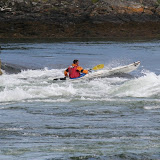
Wind was no more than force 3-4 Bft today, but after a week of westerly winds up to 5-6 Bft surf was good above the "Bollen van de Ooster" (also known as "de Aardappelenbult") a huge sandbank in the North sea, some miles west of Goeree. Nice about this spot is that you can approach it sheltered in the lee site and decide how far you want to go into the rough stuff.

Today I was here with 2 experienced (level 5 star) seakayakers. We arrived at the Aardappelenbult at high tide, the water level was about 1 meter above the sand. The waves coming from the North sea turned into surf over the sand, creating a hundreds of meters wide surf zone over a length of kilometres in the middle of the sea - a perfect play spot to train surfing and bracing skills. It's a long time ago I have had the conditions so good here. We had wonderful long rides over breaking waves, the GPS recorded speeds up to 2o kmh. It was the first time I paddled the
Anas Acuta in surfing conditions (I mostly paddle the Pintail at seatrips) and its performance was outstanding - it tracks good - no skeg needed, it's very responsive to edging and it's very manoeuvrable.

Some breaking waves were a bit awkward and one of the kayakers had wet exits in the surf zone. No problem - it's a quit safe spot. (It might take some time, but the water flows over the sand and brings the swimmer in calmer waters. The weather was fine: sunny, 20 degrees Celsius, water-temperature 18 degrees Celsius) - anyhow, a good occasion to train rescue skills in lively water. Towing a kayak with swimmer out of the surf zone is hard work, emptying a kayak in moving water in a x-rescue also. A note regarding kayak lay-out: a large cockpit design makes climbing in easier, but a high foredeck takes a lot of water when the kayak is turned over. Kayaks with large cockpits and a dayhatch often lack good decklines to grab direct in front and behind the cockpit (which makes handling the kayak and stabilizing the raft more difficult). The kayak in question was a Point65 XP, but the missing decklines over a big distance near the cockpit zone is something typical for more recent kayak-designs.

At the end of this summer recreation around the Bollen van de Ooster will become
more regulated. The complete sand will be a closed zone, even when it's flooded at high tide, and also for kayakers. There is one exception - exclusively for kayakers and windsurfers is a zone reserved at the most North-easterly tip of the "Bollen van de Ooster" (the area with the diagonal lines on the map -see below). We explored this zone today. It's a spot with good surfing conditions around high tide. I just wonder how the boundary to the closed zone will be marked: on the water you don't see any difference - it's just surf for kilometres...

Friday, July 04, 2008

Corryvreckan, Grey Dogs, Falls of Lora


Today I updated the 3rd report of the Scotland seakayak holiday. For readers that are interested in more background-information about the famous Scottish tidal races I referred to, useful weblinks are :
- The Falls of Lora Information Website by Tony Hammock;
- The Corryvreckan Whirlpool by Mike Murray - Corryvreckan Whirlpool Guide;
- Pictures of the Grey Dogs tidal race by David Philip;
- and don't forget the Seakayakphoto-weblog of Douglas Wilcox (search for the tagged items with Corryvreckan or Grey dogs)
Alas I can't cover this part of our journey with good own pictures. On these part of the trip both hands on the paddle were welcome ;-). And when I took the camera out, it immediately got wet, so the shots of the best action-moments are blurred and unsharp because of nasty drops on the lens.

For an action video of seakayaking in the Scottish tidal races: Justine Curgenven's DVD "This is the sea - part 3" covers the Falls of Lora and the Grey Dogs (click here for a preview - with a striking quote of Axel about what the Falls of Lora did to him ;-).

I suppose a "disclaimer" (or call it a little warning) is fitting here. You really can have fun with a seakayak in these places. And Govert and I did have a lot of fun! We had the unique experience of playing in the Grey Dogs with tide full running, paddling the boiling-pot and the eddy lines of the Corryvreckan 2 hours before slack water and were fighting the Falls of Lora at spring tide. We found this manageable -with 30 years of seakayaking and WW-experience together, but both without real local knowledge- but do realise we had the luck of relative calm conditions (no swell from the Atlantic and hardly any wind). And even so - these are serious and potentially dangerous waters that should always be dealt with respect! To paddle here you should be very experienced in handling rough water, be well equipped and know what to do in the case of an emergency. If you have any doubt about paddling here - be sensible and turn back. The wisest way to find your way here is to take a guide. In Oban you can find some experienced seakayak-coaches with a lot of local knowledge: ask them to take you out!

Wednesday, July 02, 2008

Modern kayak cockpit design - rolling the Tsunami120

Recently some enthusiast new members joined local kayakclub KV Wyrda. Together they form a group that is eager to learn - a pleasure to work with! Yesterday-evening I found myself teaching basic kayak-"control and safety"-skills to Maxime, Hetty, Nienke and Natascha in Reeuwijk. It was a fun and wet session: the water is warm and the weather is fine. All had a good laugh. The ladies were paddling the new club kayaks - type Wilderness Systems Tsunami 120. KV Wyrda expanded the fleet with these boats last month, to offer beginners a comfortable and stable, confidence-giving kayak to get into the sport.

I never paddled the Tsunami120 and actually only knew the boat from the pictures on the web. The beginners in the club have been paddling the Tsunamis for some weeks now. I was told that most like this boat because it's stable, comfortable and tracking well (on the placid waters around Woerden). Some of the beginners however, prefer the older club-kayaks because they are faster and paddle more effortless. Because the (PE-)Tsunami are more robust than the other club-kayaks and because I didn't plan to cover long distances with the group anyhow, I asked yesterday to take the Tsunamis to Reeuwijk.

At the end of the session I changed kayak with Nienke - It's important for a coach to place himself in the position of his pupils (in sport also physical) to understand what the pupil is feeling. It's fine to demonstrate kayak skills in the trusty seakayak, but does it work in a recreational-boat? I wanted to experience myself what the Tsunami feels like. Is this boat suited to learn leaning and edging? And in next lessons: for bracing and rolling? To be honest: my expectations weren't very high. The Tsunami is a short, wide kayak with a high deck and a padded seat with backrest that looks like an armchair. Perhaps the perfect boat for kayak-fishing or sunbathing, but not the first design that comes in my mind when I think about a kayak to learn people an active kayak-technique. As I slid in the kayak I noticed that I had underestimated the Tsunami seriously. The outfitting of the kayak invites to an active seating position and gives good support. It's easy to edge, it responds well and to my biggest surprise: it's unbelievable easy to roll. I was impressed in the five minutes I was paddling and rolling the Tsunami! This morning I went back to the clubhouse for a closer look and an ample rolling session.

The Tsunami is the "living proof" that a seating position with good contact/control is far more important than finesses in hull design. Despite the wider and flatter hull the Tsunami rolls easier than many (older) sea- ww- and greenlandkayak I paddled before. I am sure this is due to the modern ergonomic cockpit design that is incorporated in the Tsunami. Characteristics of this design are primary a wide and high position of the knees, combined with a low seat and well contoured thigh grips. The roomy seat brings also some advantage in rolling - some space to shift side to side is good. This "knees wide and high"-design has become standard in modern WW- and rodeo-kayaks - and is also getting more common in seakayaks: examples are the NDK Romany, the Explorer HV and the Rockpool Alaw - kayaks with a seating position that comes close to this principles . It's no coincidence that all these boats are known as good rollers (btw: there are surely more recent seakayaks with a similar cockpit design - these are such boats I know from personal experience...). It's a totally other philosophy than that behind the design of Greenland rolling kayaks (low deck, stretched legs, padded Masik (deck beam), snug fit).
The Greenland design is proven, for over thousand years. It's good - I won't detract from that. The "knees high and wide"-idea is perhaps ten years old. It shows that there is always potential in development -WW and rodeo ideas contribute to modern seakayaking.

It was fun Greenland rolling in the Tsunami. Looking at the pictures, you might think the high backrest hinders with layback rolls, but it doesn't: the backrest has a recline feature and tilts backwards when you lean on it. Forward endings rolls are no issue. The only downside with the clubkayaks is the miserable nylon sprayskirt. The sprayskirt looks tough, but gets loose every time you roll. So you end up rolling with an open cockpit full of water.

Monday, June 30, 2008

Smokefree at last: eating out in Holland


Scottish cuisine may not be famous around the world (Haggis?) but the quality of local produce (seafood, game and meat) is outstanding. Govert and I really enjoyed some good meals in Scottish Bars and Restaurants. Since England and Scotland have a smoking ban in bars and restaurants I find eating out even more attractive. A fascinating side-effect of the smoking ban is an almost Mediterranean eating and street culture in Britain: many outside tables, terraces and a lively outdoor scene in the streets in the evening.

From the 1th. of July the smoking ban in Dutch bars and restaurants finally is in force. I really welcome it. It makes an end with bizarre situations like yesterday. We made a reservation for a table in the smoke free zone in the Mexican restaurant in Utrecht for the birthday party of Lieke. We had a good dinner with a group of kids, really enjoyable. But despite the smoke free zone (some tables in the middle of the restaurant): the smoke of the bar and smoking zone was evenly distributed in the whole restaurant by the ventilators on the ceiling.

Friday, June 27, 2008

The last lighthouse-keeper


It looks as if the struggle is definitively lost: from 2010 on there won't be any keepers more on the Dutch lighthouses. Unmanned lighthouses is the new policy of the Dutch Traffic Department - economization and modernization. Camera's and computers will take over the tasks of the keepers.
Yesterdays' broadcast on Netwerk.tv (click for the full report - in Dutch) about this item is not an impressive piece of press-work: cheap and suggestive. Nevertheless I agree it's a bad development. The Dutch lighthouse keepers always offered the perfect local coastguard service and are since centuries an essential contribution to safety at sea. I don't believe computerization nor a central traffic-management centre will replace that.
Not only the Seakayakers are going miss the daily contact, the local knowledge and the good advises of the lighthouse keepers ;-) And I don't like the idea how kayak-incidents like this and this would have ended without the local coastguard support of the lighthouse crews!

Wednesday, June 25, 2008

Scotland journey - 3: from Oban to Scarba, Jura and the Slate Isles

Pulling down the tent on Belnahua - Lunga, Scarban and Jura in the background.
Fast water in the "Grey dogs"-tidal races between Lunga and Scarba
Paddling on a mirror in the Shuna Sound

The story continues: the report of the 3 stage of the Scotland-trip Govert and I made.

Sorry: the day by day report is "under construction". Click on the Picasa-miniature for a slide show/picture report.
oban-belnahua-scarba-jura-seil

Updated 4th July:
With new supplies from the Tesco (fresh food and drinks) and after a relaxed day around Kererra island, we were ready for the next challenge: a multiple day trip to the Slate Isles, Scarba, Jura and the famous whirlpool and tidal races in this area: the Corryvreckan, Grey Dogs, Dorus Mor etc. Places full of history full, legends and myths, still regarded with respect by seafarers all over the world. We took four days from Oban to discover this magnificent area – which is of outstanding beauty!

Sat. 31th. May : Oban-Belnahua, 25 km, SW 3-4 later Var.
Paddling late in the afternoon from Seil to Belanahua we heard an emergency-call on Channel 16 on the VHF-radio. A little vessel had serious problems in the Gulf of Corryvreckan. Two persons on board lost control. The coastguard contacted a fast RIB near the Gulf and started immediately coordinating the rescue operation. We heard glimps of it life on the radio. It turned out well, but it added to the myths of the Corryvreckan – the Whirlpool we wanted to explore the next day…
It was a nice paddle from Oban tot the Slate isles, passing by Seil and Easdale. South of Seil began the area with currents noticeably stronger than near Oban and Mull. We were paddling against a light breeze but had the current with us. It was a pleasant paddle, but not my luckiest day. I lost my (waist-mounted)tow-line. Probably because I had forgotten to gear it on after the break. Half way between Easdale and Belnahua I suddenly missed the tow-line. We paddled back to Easdale to look for it (meaning an extra 6 km paddling, half of it against the current – don’t mind - we like paddling ;-) but didn’t find it. And after this incident with unpacking on Belnahua I found that the rear compartment of my kayak was flooded with liters of salt water. Fortunately I had packed the essentials, like the sleeping-bag, in drybags, so the damage was harmless (only my notebook and the Rough Guide for Scotland were wetted). It was sunny, dry and windy on Belnahua (no midges!) so everything dried fast. On the following days the compartment stayed totally dry - so I suppose the leakage was caused by a not properly closed rubber hatch. Closing the oval Valley-hatches is always a bit critical.

Sun. 1th. June: Belnahua-Lunga-Grey Dogs-Scarba- Corryvreckan-Jura, 3-4 Bft. Var. later SW.
This was the day for the races. In the morning there was a light breeze, but that was gone when we started paddling in the middle of late after noon. We started late because we wanted to play in the Grey Dogs with tide full running and slack water in the Corryvreckan was at nine in the evening. One of the advantages of paddling early June is that the days are long! Crossing to and paddling along Lunga we had the tide against us, but despite this we made good speed using eddies along the west-coast of Lunga. This gave us plenty of time for a break before going in the Grey Dogs. We enjoyed the last sun of the day on a rocky isle before the entrance of the Grey Dogs. Heading in the Grey Dogs the sky turned very grey and it started raining, but we didn’t mind – we had just changed in our drysuits and the playing in the Grey Dogs is a wet anyhow! The Grey Dogs are a perfect playspot with a standing wave and a lot of eddies around the rock in the middle of the race. Water was pressed with high speed through the small passage between Lunga and Scarba. We left with paddling speeds up to 18km/h! When the tide was decreasing we paddled south along the Scarba coast – to have dinner at the south-east tip of Scarba- and to wait for slack water in the Gulf of Corryvreckan. Dining at Scarba wasn’t to pleasant – plagued by millions of midges – cooking and eating with a midge-net on the head ;-( So as we had finished out meals we decided not to wait any longer and to see how we could ferry-glide to Jura with the Corryvreckan still running. Which was surprisingly manageable – despite all the dramatic stories we were told. Water was running very fast (one big boiling pot) but as there was hardly any wind we managed to gain good progress in the eddies and arrived at Jura an hour before planned.

Mon. 2nd June. Jura-Corryvreckan-Shuna Sound-Torsa-Seil Sound- Bridge over the Atlantic-Seil, 30 km 3-4 Var, lat. 5/6 SW
After a rainy night on Jura we left early to paddle two hours against the ebb-stream in the Gulf of Corryvreckan, before the tide would turn and the flood would take us back to the Luing and the Sound of Shuna. The streaming water in the Corryvreckan was impressive: boiling water, whirlpools, suddenly holes in the water, eddylines everywhere, constantly changing. Even under these optimal conditions a place to be handled with care! A big contrast with the mirror-like Shuna sound – only a few hours later. The weather forecast told something different but in the morning clouds and wind disappeared. We had a coffee break in Toberonochy on Luing and were happy to change clothes – swapping from drysuits into shorts with t-shirt!
In the evening we camped on Seil and had a good meal in the Tigh-an-Truish Inn (Tigh an Truish means 'house of the trousers' and comes from the period after the 1745 Jacobite rebellion when kilts were banned in Scottish mainland. Islanders heading for the mainland are supposed to have stopped here to swap their kilts for trousers).
It was tempting to stay more days roaming around Jura, Scarba and the Slate Isles. The Garvelachs and Jura are still to be discovered, but we had other plans: we wanted to be back in Oban on Tuesday, because Wednesday was spring tide and the best day in the two weeks we were in Scotland to enjoy the Falls of Lora…

Tue. 3rd June, Seil-Sound of Kerrera-Oban, 10 km SW backing SE 4-5, 6 at times
With a backing wind a fast ride back to Oban. Regarding the weather: we were very lucky with our weather window! Continuously the radio was talking about rain and showers – we had occasionally some drops, but mostly sun – Scotland in a Mediterranean mood!

Click on the miniature for the GPS-tracklog, 85 km.


Wednesday, June 18, 2008

Espresso for ocean paddlers


I am not a coffee drinker. But with this new gadget I would almost turn into one. On the Oban campsite Gerard demonstrated us his latest toy: the Handpresso coffee maker.
Gerard intended to surprise his fellow paddlers Nout and Patrick with a quality coffee break half way on the trip to St.Kilda. Enjoying a fresh cup of espresso with a delicious aroma and a perfect crema - in the cockpit a seakayak, in the middle of the ocean: awesome!
This week the 3 St. Kilda paddlers come back - I am looking forward to their stories!

Update 25 th. June: Patrick, Gerard and Nout are back home. Patrick told me they didn't make it to St-Kilda due to the unstable and windy weather. The forecasts and the actual weather-situation were to uncertain to risk the long crossing to St-Kilda. Instead they had a good time paddling around in the Outer Herbrides and near Skye. Alas: For Gerard the last week was not that pleasant - he broke a bone in his foot (while carrying the kayaks on a pebble beach) and ended up in hospital and got his leg plastered...

Scotland journey 2: Rounding Kerrera


Back from Mull we camped at the caravanpark in Oban (Gallanach Farm, next to the sound of Kerrera). After a tiring climb to the Ben More the day before and with a trip to the slate isles in prospect, a resting day was welcome. A day off would also be a good occasion to dry and vent the camping and kayak gear and to resupply our food and drinks for the next multiple day-trip. The Tesco in Oban is a perfect kayak-expedition supplier.

What to do on a resting day? Paddling of course - it's a holiday ;-) We decided it would be a pity not to paddle on such a perfect day and left the car at the campsite and put the kayaks in the water to visit the Tesco in Oban. From the caravanpark we first headed south on the Sound of Kerrera to round the isle of Kerrera. Kerrera is a low lying island in the Firth of Lorn that shelters Oban from the worst of westerly winds. It's rural character is a big contrast to the crowded Oban. The south coast is rough, with Gylen Castle in a majestic clifftop setting. On the west-coast Kerrera offers some fine sandy beaches. The view on Mull, Lismore, the Scottish Highlands is fantastic. We started with a light wind, but on the west-coast the wind disappeared completely and we were paddling on a blue mirror. After a picnic on Slatrach Bay we paddled into the harbour of Oban.

A big surprise as we packed our new supplies in the kayaks. We heard a familiar voice calling "Hi Hans, Hi Govert!" - it was Gerard, a Dutch paddler. Gerard was in Oban awaiting Nout and Patrick, who would come to Scotland some days later, for their kayak-expedition to St. Kilda. What a coincidence! Gerard joined us at the campsite in the evening. We were fascinated by the stories about their preparation for the St. Kilda trip - an open crossing of 60 km's on the Atlantic. Govert and I were having a kayak-holiday. The adventure of Gerard and his friends is a kayak- expedition!

Friday, 30th. May, wind 2/3 Var, sea state slight, sunny.
Oban-Kerrera Island-Oban, 23 km

Meanwhile in Woerden...

Black Tuiliq by Reed-Chillcheater, picture by Janine
With all the recent postings about Scotland, it looks like there is nothing going on with kayaking in Woerden in the mean time. That's the wrong impression: kayakclub KV Wyrda is bursting with activities lately. The new group of youngsters is steadily growing and has almost every weekend a training session or a daytrip under supervision of Rob and Rob. The new members of Wyrda (all women...) have had an introduction course by Jan and are now very regular participants of the club-paddle on Tuesday evening. Alex is teaching Open canoe-techniques on the club-evenings. And so on...
The weather is fine lately and the water is warm. Paddling on the calm waters around Woerden is very uncomplicated and so relaxed. Simply pick up your kayak and enjoy the water! I personally love to take the K1 racer for a speed paddle with the wing-blade, or to jump in the black Reed-tuiliq for a rolling session with my hand-carved greenland-paddle.

Btw: The tuiliq does also a good job as "little party dress". Woerdens' parties are rather innocent ;-)