Thursday, July 17, 2008

Scotland journey 5 - final: Lismore and Shuna Island


Early morning atmosphere in Loch Linnhe.

After visiting the Falls of Lora Govert and I had done all the highlights we planned. We were so lucky to have 2 more days left over and felt like another kayak-camping trip. Circumnavigating the Isles of Lismore and Shuna in Loch Linnhe was a fitting option. Starting point was the Pierhouse hotel at Port Appin - a perfect place to embark: with a easy accessible pebble beach direct in front of the car parking and the comfort of a good restaurant at start and finish of the trip (note: there is not much parking place in Port Appin, I won't advise it at busy days!).

Thursday was the first and only day during our Scotland-journey that it was clouded, raining an drizzling all day long. Yet it wasn't an unpleasant day - actually the drizzling atmosphere made the experience of the impressive scenery of Loch Linnhe, surrounded by the Scottish Mountains even more intense. Porpoises and seals accompanied us on our paddle. We headed from Port Appin south to Lismore Lighthouse where we had planned the first stop. Arriving at Lismore point however, it wasn't to appealing to get out there in the rain. The next few places to land (which are rather scarce at low tide) were all occupied by seals or seabirds we didn't want to disturb. Finally we paddled over 30 km's before we got out of the kayaks for an extensive break. Cooking water (Tea (Hans, Coffee (Govert))took a bit longer because the MSR-Whisperlite cooker needed an in the field repair. Sometimes these cookers refuse to work properly for some vague reason, but after repeated disassembly and assembly they always recover in the end.

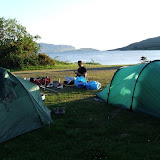
After the break it was just 10 more kilometres to the Northern tip of Lismore, where we camped between the sheep. The next morning was fantastic - it had stopped raining, and while the clouds slowly disappeared, the impressive Scottish mountains around the mirror like Loch Linnhe appeared. Shuna is only a little isle - so there was no reason to hurry. Between Shuna and Port Appin lies the picturesque site of Castle Stalker. We arrived at the Pierhouse hotel before lunchtime. The hotel-manager welcomed us friendly in Dutch. It turned out she had worked in Leiden in the Netherlands in younger years. After unloading the kayaks, packing the car and changing clothes we celebrated the end of a fantastic journey with fresh seafood in the Pierhouse Hotel. Scotland has made a marvellous impression - we are devoted!

Lismore- Shuna

Click on the Picasa miniature for more pictures of Shuna and Lismore.

Thursday 5th June, 38 km, Port Appin - circumnavigating Lismore - no wind, rainy
Friday 6th June, 12 km, Lismore - Shuna Island - Port Appin - no wind

Scotland journey - 4: survival paddling in the Falls of Lora

It's about time to finish the series of reports of the Scotland-journey: meanwhile Scotland more than a month ago and the next vacation is coming in a few days... So here are the reports of the last two stages: first our morning-paddle in the Falls of Lora (Click on the link for detailed information about this marvellous playspot). Twice a day ebb and flood press the water of Loch Etive through the narrows under the Connel Bridge near Oban. At spring tides the tidal range is around 4 meters and roughly 45,000,000 cubic meters is finding it's way out. That's a lot of water with tremendous power.


The video of Nicampbell on Youtube shows more than words can. In Justine Curgenvens' video "This is the sea 3" you can admire some skilled seakayakers surfing on the Falls of Lora (the first shots of the TITS3-trailer are taken on the Falls of Lora, Axels' quote about his "wetted pants" refers to his wet exit in the falls). With this in mind the Falls of Lora were a must-do for us.
We timed the best ebb spring tide and went for it. It was absolutely awesome: the first two hours when the tide was full running. To be fair it was more "survival paddling" than "playing with the waves", but what a fun it was, surfing, bracing, rolling! It was a completely different experience than I am used to paddling in surf at sea. The water is salt and the sea is the scenery, but actually it's more white water-river paddling than seakayaking. Of the experiences I had in my kayaking career paddling the Dutch Water Dreams-track comes closest to it.
Govert is the more experienced WW-kayaker of the two of us. He dealt amazingly well with his Dawntrader-seakayak, but he swam also a bit more than I - because he pushed it more to the limit than I did. That's what a "re-entry and roll-self rescue" is good for... And thanks to Justines' video we know that we needn't to be ashamed with our wet-exits: when even Axel and Freya do -> we are in good company ;-) Nevertheless we both decided to pick up ww-kayaking and to make an appointment for the DWD-track this summer. There was nobody to take pictures or to film of our adventures in the Falls of Lora - I only managed to make some shots at the more tranquil moments. The Falls of Lora truly deserve the titel of seakayakers' Nirvana!
Falls of Lora

Wednesday, July 16, 2008

Monty Python and the Holy Grail - Castle Aaaaarrrrrrggghhh


King Arthur and Sir Lancelot the Brave in the final scene of Monthy Python and the Holy Grail, Python Pictures Ltd, 1974

Yesterday I watched the DVD of Monty Python and the Holy Grail together with the kids. It's fascinating to notice that the 35 years old humour of Monty Python still appeals to modern teenagers. I had a great evening too, enjoying all time classics like discussions of coconuts and swallows, a black knight losing limbs, the knights who say Ni, the killer rabbit and the other great scenes. At the end of the film Castle Aaaaarrrrrrggghhh looked suddenly very familiar: I recognized Castle Stalker near Fort Appin. Govert and I passed the picturesque castle in Loch Linnhe on the last day of our Scotland kayak-journey - at that moment not realizing to be paddling in the footsteps of Arthur and Lancelot, so close to the Holy Grail ;-)


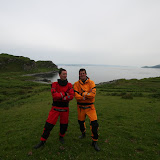
Govert and Hans in the final stage of the Scotland-kayaktrip, Govert Plugge/Hans Heupink, 2008.

Sunday, July 13, 2008

The surfspot on the "Bollen van de Ooster" aka "de Aardappelenbult"

No action pictures today because my beloved old Sony DSC-U60 underwatercamera refused to do its job. I am afraid it's getting time for a new water proof digital camera. Alas Sony doesn't produce a worthy successor, and I am not very impressed by the waterproof cameras of the other brands. Perhaps the new Pentax W60 - has anyone already tried this camera?

Wind was no more than force 3-4 Bft today, but after a week of westerly winds up to 5-6 Bft surf was good above the "Bollen van de Ooster" (also known as "de Aardappelenbult") a huge sandbank in the North sea, some miles west of Goeree. Nice about this spot is that you can approach it sheltered in the lee site and decide how far you want to go into the rough stuff.

Today I was here with 2 experienced (level 5 star) seakayakers. We arrived at the Aardappelenbult at high tide, the water level was about 1 meter above the sand. The waves coming from the North sea turned into surf over the sand, creating a hundreds of meters wide surf zone over a length of kilometres in the middle of the sea - a perfect play spot to train surfing and bracing skills. It's a long time ago I have had the conditions so good here. We had wonderful long rides over breaking waves, the GPS recorded speeds up to 2o kmh. It was the first time I paddled the
Anas Acuta in surfing conditions (I mostly paddle the Pintail at seatrips) and its performance was outstanding - it tracks good - no skeg needed, it's very responsive to edging and it's very manoeuvrable.

Some breaking waves were a bit awkward and one of the kayakers had wet exits in the surf zone. No problem - it's a quit safe spot. (It might take some time, but the water flows over the sand and brings the swimmer in calmer waters. The weather was fine: sunny, 20 degrees Celsius, water-temperature 18 degrees Celsius) - anyhow, a good occasion to train rescue skills in lively water. Towing a kayak with swimmer out of the surf zone is hard work, emptying a kayak in moving water in a x-rescue also. A note regarding kayak lay-out: a large cockpit design makes climbing in easier, but a high foredeck takes a lot of water when the kayak is turned over. Kayaks with large cockpits and a dayhatch often lack good decklines to grab direct in front and behind the cockpit (which makes handling the kayak and stabilizing the raft more difficult). The kayak in question was a Point65 XP, but the missing decklines over a big distance near the cockpit zone is something typical for more recent kayak-designs.

At the end of this summer recreation around the Bollen van de Ooster will become
more regulated. The complete sand will be a closed zone, even when it's flooded at high tide, and also for kayakers. There is one exception - exclusively for kayakers and windsurfers is a zone reserved at the most North-easterly tip of the "Bollen van de Ooster" (the area with the diagonal lines on the map -see below). We explored this zone today. It's a spot with good surfing conditions around high tide. I just wonder how the boundary to the closed zone will be marked: on the water you don't see any difference - it's just surf for kilometres...

Friday, July 04, 2008

Corryvreckan, Grey Dogs, Falls of Lora


Today I updated the 3rd report of the Scotland seakayak holiday. For readers that are interested in more background-information about the famous Scottish tidal races I referred to, useful weblinks are :
- The Falls of Lora Information Website by Tony Hammock;
- The Corryvreckan Whirlpool by Mike Murray - Corryvreckan Whirlpool Guide;
- Pictures of the Grey Dogs tidal race by David Philip;
- and don't forget the Seakayakphoto-weblog of Douglas Wilcox (search for the tagged items with Corryvreckan or Grey dogs)
Alas I can't cover this part of our journey with good own pictures. On these part of the trip both hands on the paddle were welcome ;-). And when I took the camera out, it immediately got wet, so the shots of the best action-moments are blurred and unsharp because of nasty drops on the lens.

For an action video of seakayaking in the Scottish tidal races: Justine Curgenven's DVD "This is the sea - part 3" covers the Falls of Lora and the Grey Dogs (click here for a preview - with a striking quote of Axel about what the Falls of Lora did to him ;-).

I suppose a "disclaimer" (or call it a little warning) is fitting here. You really can have fun with a seakayak in these places. And Govert and I did have a lot of fun! We had the unique experience of playing in the Grey Dogs with tide full running, paddling the boiling-pot and the eddy lines of the Corryvreckan 2 hours before slack water and were fighting the Falls of Lora at spring tide. We found this manageable -with 30 years of seakayaking and WW-experience together, but both without real local knowledge- but do realise we had the luck of relative calm conditions (no swell from the Atlantic and hardly any wind). And even so - these are serious and potentially dangerous waters that should always be dealt with respect! To paddle here you should be very experienced in handling rough water, be well equipped and know what to do in the case of an emergency. If you have any doubt about paddling here - be sensible and turn back. The wisest way to find your way here is to take a guide. In Oban you can find some experienced seakayak-coaches with a lot of local knowledge: ask them to take you out!

Wednesday, July 02, 2008

Modern kayak cockpit design - rolling the Tsunami120

Recently some enthusiast new members joined local kayakclub KV Wyrda. Together they form a group that is eager to learn - a pleasure to work with! Yesterday-evening I found myself teaching basic kayak-"control and safety"-skills to Maxime, Hetty, Nienke and Natascha in Reeuwijk. It was a fun and wet session: the water is warm and the weather is fine. All had a good laugh. The ladies were paddling the new club kayaks - type Wilderness Systems Tsunami 120. KV Wyrda expanded the fleet with these boats last month, to offer beginners a comfortable and stable, confidence-giving kayak to get into the sport.

I never paddled the Tsunami120 and actually only knew the boat from the pictures on the web. The beginners in the club have been paddling the Tsunamis for some weeks now. I was told that most like this boat because it's stable, comfortable and tracking well (on the placid waters around Woerden). Some of the beginners however, prefer the older club-kayaks because they are faster and paddle more effortless. Because the (PE-)Tsunami are more robust than the other club-kayaks and because I didn't plan to cover long distances with the group anyhow, I asked yesterday to take the Tsunamis to Reeuwijk.

At the end of the session I changed kayak with Nienke - It's important for a coach to place himself in the position of his pupils (in sport also physical) to understand what the pupil is feeling. It's fine to demonstrate kayak skills in the trusty seakayak, but does it work in a recreational-boat? I wanted to experience myself what the Tsunami feels like. Is this boat suited to learn leaning and edging? And in next lessons: for bracing and rolling? To be honest: my expectations weren't very high. The Tsunami is a short, wide kayak with a high deck and a padded seat with backrest that looks like an armchair. Perhaps the perfect boat for kayak-fishing or sunbathing, but not the first design that comes in my mind when I think about a kayak to learn people an active kayak-technique. As I slid in the kayak I noticed that I had underestimated the Tsunami seriously. The outfitting of the kayak invites to an active seating position and gives good support. It's easy to edge, it responds well and to my biggest surprise: it's unbelievable easy to roll. I was impressed in the five minutes I was paddling and rolling the Tsunami! This morning I went back to the clubhouse for a closer look and an ample rolling session.

The Tsunami is the "living proof" that a seating position with good contact/control is far more important than finesses in hull design. Despite the wider and flatter hull the Tsunami rolls easier than many (older) sea- ww- and greenlandkayak I paddled before. I am sure this is due to the modern ergonomic cockpit design that is incorporated in the Tsunami. Characteristics of this design are primary a wide and high position of the knees, combined with a low seat and well contoured thigh grips. The roomy seat brings also some advantage in rolling - some space to shift side to side is good. This "knees wide and high"-design has become standard in modern WW- and rodeo-kayaks - and is also getting more common in seakayaks: examples are the NDK Romany, the Explorer HV and the Rockpool Alaw - kayaks with a seating position that comes close to this principles . It's no coincidence that all these boats are known as good rollers (btw: there are surely more recent seakayaks with a similar cockpit design - these are such boats I know from personal experience...). It's a totally other philosophy than that behind the design of Greenland rolling kayaks (low deck, stretched legs, padded Masik (deck beam), snug fit).
The Greenland design is proven, for over thousand years. It's good - I won't detract from that. The "knees high and wide"-idea is perhaps ten years old. It shows that there is always potential in development -WW and rodeo ideas contribute to modern seakayaking.

It was fun Greenland rolling in the Tsunami. Looking at the pictures, you might think the high backrest hinders with layback rolls, but it doesn't: the backrest has a recline feature and tilts backwards when you lean on it. Forward endings rolls are no issue. The only downside with the clubkayaks is the miserable nylon sprayskirt. The sprayskirt looks tough, but gets loose every time you roll. So you end up rolling with an open cockpit full of water.

Monday, June 30, 2008

Smokefree at last: eating out in Holland


Scottish cuisine may not be famous around the world (Haggis?) but the quality of local produce (seafood, game and meat) is outstanding. Govert and I really enjoyed some good meals in Scottish Bars and Restaurants. Since England and Scotland have a smoking ban in bars and restaurants I find eating out even more attractive. A fascinating side-effect of the smoking ban is an almost Mediterranean eating and street culture in Britain: many outside tables, terraces and a lively outdoor scene in the streets in the evening.

From the 1th. of July the smoking ban in Dutch bars and restaurants finally is in force. I really welcome it. It makes an end with bizarre situations like yesterday. We made a reservation for a table in the smoke free zone in the Mexican restaurant in Utrecht for the birthday party of Lieke. We had a good dinner with a group of kids, really enjoyable. But despite the smoke free zone (some tables in the middle of the restaurant): the smoke of the bar and smoking zone was evenly distributed in the whole restaurant by the ventilators on the ceiling.

Friday, June 27, 2008

The last lighthouse-keeper


It looks as if the struggle is definitively lost: from 2010 on there won't be any keepers more on the Dutch lighthouses. Unmanned lighthouses is the new policy of the Dutch Traffic Department - economization and modernization. Camera's and computers will take over the tasks of the keepers.
Yesterdays' broadcast on Netwerk.tv (click for the full report - in Dutch) about this item is not an impressive piece of press-work: cheap and suggestive. Nevertheless I agree it's a bad development. The Dutch lighthouse keepers always offered the perfect local coastguard service and are since centuries an essential contribution to safety at sea. I don't believe computerization nor a central traffic-management centre will replace that.
Not only the Seakayakers are going miss the daily contact, the local knowledge and the good advises of the lighthouse keepers ;-) And I don't like the idea how kayak-incidents like this and this would have ended without the local coastguard support of the lighthouse crews!

Wednesday, June 25, 2008

Scotland journey - 3: from Oban to Scarba, Jura and the Slate Isles

Pulling down the tent on Belnahua - Lunga, Scarban and Jura in the background.
Fast water in the "Grey dogs"-tidal races between Lunga and Scarba
Paddling on a mirror in the Shuna Sound

The story continues: the report of the 3 stage of the Scotland-trip Govert and I made.

Sorry: the day by day report is "under construction". Click on the Picasa-miniature for a slide show/picture report.
oban-belnahua-scarba-jura-seil

Updated 4th July:
With new supplies from the Tesco (fresh food and drinks) and after a relaxed day around Kererra island, we were ready for the next challenge: a multiple day trip to the Slate Isles, Scarba, Jura and the famous whirlpool and tidal races in this area: the Corryvreckan, Grey Dogs, Dorus Mor etc. Places full of history full, legends and myths, still regarded with respect by seafarers all over the world. We took four days from Oban to discover this magnificent area – which is of outstanding beauty!

Sat. 31th. May : Oban-Belnahua, 25 km, SW 3-4 later Var.
Paddling late in the afternoon from Seil to Belanahua we heard an emergency-call on Channel 16 on the VHF-radio. A little vessel had serious problems in the Gulf of Corryvreckan. Two persons on board lost control. The coastguard contacted a fast RIB near the Gulf and started immediately coordinating the rescue operation. We heard glimps of it life on the radio. It turned out well, but it added to the myths of the Corryvreckan – the Whirlpool we wanted to explore the next day…
It was a nice paddle from Oban tot the Slate isles, passing by Seil and Easdale. South of Seil began the area with currents noticeably stronger than near Oban and Mull. We were paddling against a light breeze but had the current with us. It was a pleasant paddle, but not my luckiest day. I lost my (waist-mounted)tow-line. Probably because I had forgotten to gear it on after the break. Half way between Easdale and Belnahua I suddenly missed the tow-line. We paddled back to Easdale to look for it (meaning an extra 6 km paddling, half of it against the current – don’t mind - we like paddling ;-) but didn’t find it. And after this incident with unpacking on Belnahua I found that the rear compartment of my kayak was flooded with liters of salt water. Fortunately I had packed the essentials, like the sleeping-bag, in drybags, so the damage was harmless (only my notebook and the Rough Guide for Scotland were wetted). It was sunny, dry and windy on Belnahua (no midges!) so everything dried fast. On the following days the compartment stayed totally dry - so I suppose the leakage was caused by a not properly closed rubber hatch. Closing the oval Valley-hatches is always a bit critical.

Sun. 1th. June: Belnahua-Lunga-Grey Dogs-Scarba- Corryvreckan-Jura, 3-4 Bft. Var. later SW.
This was the day for the races. In the morning there was a light breeze, but that was gone when we started paddling in the middle of late after noon. We started late because we wanted to play in the Grey Dogs with tide full running and slack water in the Corryvreckan was at nine in the evening. One of the advantages of paddling early June is that the days are long! Crossing to and paddling along Lunga we had the tide against us, but despite this we made good speed using eddies along the west-coast of Lunga. This gave us plenty of time for a break before going in the Grey Dogs. We enjoyed the last sun of the day on a rocky isle before the entrance of the Grey Dogs. Heading in the Grey Dogs the sky turned very grey and it started raining, but we didn’t mind – we had just changed in our drysuits and the playing in the Grey Dogs is a wet anyhow! The Grey Dogs are a perfect playspot with a standing wave and a lot of eddies around the rock in the middle of the race. Water was pressed with high speed through the small passage between Lunga and Scarba. We left with paddling speeds up to 18km/h! When the tide was decreasing we paddled south along the Scarba coast – to have dinner at the south-east tip of Scarba- and to wait for slack water in the Gulf of Corryvreckan. Dining at Scarba wasn’t to pleasant – plagued by millions of midges – cooking and eating with a midge-net on the head ;-( So as we had finished out meals we decided not to wait any longer and to see how we could ferry-glide to Jura with the Corryvreckan still running. Which was surprisingly manageable – despite all the dramatic stories we were told. Water was running very fast (one big boiling pot) but as there was hardly any wind we managed to gain good progress in the eddies and arrived at Jura an hour before planned.

Mon. 2nd June. Jura-Corryvreckan-Shuna Sound-Torsa-Seil Sound- Bridge over the Atlantic-Seil, 30 km 3-4 Var, lat. 5/6 SW
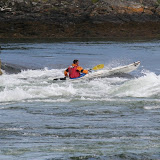
After a rainy night on Jura we left early to paddle two hours against the ebb-stream in the Gulf of Corryvreckan, before the tide would turn and the flood would take us back to the Luing and the Sound of Shuna. The streaming water in the Corryvreckan was impressive: boiling water, whirlpools, suddenly holes in the water, eddylines everywhere, constantly changing. Even under these optimal conditions a place to be handled with care! A big contrast with the mirror-like Shuna sound – only a few hours later. The weather forecast told something different but in the morning clouds and wind disappeared. We had a coffee break in Toberonochy on Luing and were happy to change clothes – swapping from drysuits into shorts with t-shirt!
In the evening we camped on Seil and had a good meal in the Tigh-an-Truish Inn (Tigh an Truish means 'house of the trousers' and comes from the period after the 1745 Jacobite rebellion when kilts were banned in Scottish mainland. Islanders heading for the mainland are supposed to have stopped here to swap their kilts for trousers).
It was tempting to stay more days roaming around Jura, Scarba and the Slate Isles. The Garvelachs and Jura are still to be discovered, but we had other plans: we wanted to be back in Oban on Tuesday, because Wednesday was spring tide and the best day in the two weeks we were in Scotland to enjoy the Falls of Lora…

Tue. 3rd June, Seil-Sound of Kerrera-Oban, 10 km SW backing SE 4-5, 6 at times
With a backing wind a fast ride back to Oban. Regarding the weather: we were very lucky with our weather window! Continuously the radio was talking about rain and showers – we had occasionally some drops, but mostly sun – Scotland in a Mediterranean mood!

Click on the miniature for the GPS-tracklog, 85 km.


Wednesday, June 18, 2008

Espresso for ocean paddlers


I am not a coffee drinker. But with this new gadget I would almost turn into one. On the Oban campsite Gerard demonstrated us his latest toy: the Handpresso coffee maker.
Gerard intended to surprise his fellow paddlers Nout and Patrick with a quality coffee break half way on the trip to St.Kilda. Enjoying a fresh cup of espresso with a delicious aroma and a perfect crema - in the cockpit a seakayak, in the middle of the ocean: awesome!
This week the 3 St. Kilda paddlers come back - I am looking forward to their stories!

Update 25 th. June: Patrick, Gerard and Nout are back home. Patrick told me they didn't make it to St-Kilda due to the unstable and windy weather. The forecasts and the actual weather-situation were to uncertain to risk the long crossing to St-Kilda. Instead they had a good time paddling around in the Outer Herbrides and near Skye. Alas: For Gerard the last week was not that pleasant - he broke a bone in his foot (while carrying the kayaks on a pebble beach) and ended up in hospital and got his leg plastered...

Scotland journey 2: Rounding Kerrera


Back from Mull we camped at the caravanpark in Oban (Gallanach Farm, next to the sound of Kerrera). After a tiring climb to the Ben More the day before and with a trip to the slate isles in prospect, a resting day was welcome. A day off would also be a good occasion to dry and vent the camping and kayak gear and to resupply our food and drinks for the next multiple day-trip. The Tesco in Oban is a perfect kayak-expedition supplier.

What to do on a resting day? Paddling of course - it's a holiday ;-) We decided it would be a pity not to paddle on such a perfect day and left the car at the campsite and put the kayaks in the water to visit the Tesco in Oban. From the caravanpark we first headed south on the Sound of Kerrera to round the isle of Kerrera. Kerrera is a low lying island in the Firth of Lorn that shelters Oban from the worst of westerly winds. It's rural character is a big contrast to the crowded Oban. The south coast is rough, with Gylen Castle in a majestic clifftop setting. On the west-coast Kerrera offers some fine sandy beaches. The view on Mull, Lismore, the Scottish Highlands is fantastic. We started with a light wind, but on the west-coast the wind disappeared completely and we were paddling on a blue mirror. After a picnic on Slatrach Bay we paddled into the harbour of Oban.

A big surprise as we packed our new supplies in the kayaks. We heard a familiar voice calling "Hi Hans, Hi Govert!" - it was Gerard, a Dutch paddler. Gerard was in Oban awaiting Nout and Patrick, who would come to Scotland some days later, for their kayak-expedition to St. Kilda. What a coincidence! Gerard joined us at the campsite in the evening. We were fascinated by the stories about their preparation for the St. Kilda trip - an open crossing of 60 km's on the Atlantic. Govert and I were having a kayak-holiday. The adventure of Gerard and his friends is a kayak- expedition!

Friday, 30th. May, wind 2/3 Var, sea state slight, sunny.
Oban-Kerrera Island-Oban, 23 km

Meanwhile in Woerden...

Black Tuiliq by Reed-Chillcheater, picture by Janine
With all the recent postings about Scotland, it looks like there is nothing going on with kayaking in Woerden in the mean time. That's the wrong impression: kayakclub KV Wyrda is bursting with activities lately. The new group of youngsters is steadily growing and has almost every weekend a training session or a daytrip under supervision of Rob and Rob. The new members of Wyrda (all women...) have had an introduction course by Jan and are now very regular participants of the club-paddle on Tuesday evening. Alex is teaching Open canoe-techniques on the club-evenings. And so on...
The weather is fine lately and the water is warm. Paddling on the calm waters around Woerden is very uncomplicated and so relaxed. Simply pick up your kayak and enjoy the water! I personally love to take the K1 racer for a speed paddle with the wing-blade, or to jump in the black Reed-tuiliq for a rolling session with my hand-carved greenland-paddle.

Btw: The tuiliq does also a good job as "little party dress". Woerdens' parties are rather innocent ;-)

Sunday, June 15, 2008

Munro bagging


A Munro is a Scottish mountain with a height over 3,000 feet (914.4 metres). They are named after Sir Hugh Munro (1856–1919), who produced the first compilation of a catalogue of such hills, known as Munro's Tables, in 1891. Sir Hugh Munro's original list, published in the Scottish Mountaineering Club Journal in September 1891, listed 538 summits over 3000 feet, of which 283 were regarded as "separate mountains"; the term Munro applies to the latter, while the lesser summits are known as tops. Some hillwalkers climb Munros with an eye to climbing every single one, a practice known as "Munro bagging". Having climbed all of them, a walker is entitled to be called a Munroist. Munro-bagging is the most popular form of peak bagging. - source: Wikipedia.

Ben More (Scottish Gaelic: Beinn Mhòr, meaning "great mountain") is the highest mountain and only Munro on the Isle of Mull, Scotland. Despite their modest height the Scottish Mountains have quit an Alpine character due to the latitude and exposure to Atlantic weather systems. Even in summer, conditions can be tricky: thick fog, strong winds, driving rain and freezing summit temperatures are not unusual.
On Thursday 29. June we broke up the tents at the Killiechronan campsite to take the ferry from the Isle of Mull back to Oban for the second part of our kayak journey (to the Slate Isles). But before leaving Mull we walked upon the Ben More for an overview of what we paddled the days before an of what to come the next week.
We started the walk in the morning at sea-level in Dhiseigh in T-shirt with sunshine and very pleasant temperatures, above 600 meters we walked into the clouds and on top of the Ben More, after a walk of less than 2 hours, it was freezing cold and visibility was less than 20 meters... In the fog on the top we met a couple that was celebrating their first Munro too. Packed in fleece and jackets, enjoying a warm cup of tea (with the delightful Tesco-Chocolate Muffins) we paused, hoping that the fog would disappear. After half an hour sky suddenly broke open - offering fantastic panoramas between breaking clouds.

The first Munro tastes like more (but the number of 283 is a bit excessive, beyond normal limits ;-)!

Thursday, June 12, 2008

Midges

Midges are tiny insects with a wingspan of just 1-2mm. They suck blood from the skin, causing itching and swelling that can last several days. In summer, midges that bite people can reach vast numbers and become a real problem for both locals and tourists - the Scottish Midge Forecast

Amidst the preparation and the pleasurable anticipation for the Scotland-trip there is one issue I hopelessly underestimated: the Midges. Sure I heard about them and I packed a repellent with a high DEET-concentration, but I wasn't aware of the impact of these little "friends".
In the Netherlands we have "muggen" - Gnats. Dutch gnats don't like my blood, mostly the others get bitten, not me.. In Scotland however I discovered that the Scottish Midges love my blood. It's a cold comfort that only the female midges bite. There were thousands of these tiny girlie insects just waiting to put their cheeks in my skin (and these cheeks are each sporting 20 razor-sharp teeth). It's quit a nuisance to be that popular - especially because the result of the bites proved to be very itchy, a nuisance that lasted for days. Don't scratch!

The effect of the repellent proved to be only temporary, so I was very glad that Govert had taken an extra midge net along... The combination of a midge net and a Goretex dry-suit offers quit good protection, only you don't want to wear that gear all day...

Picture taken on Scarba. Scarba and Jura were the places most plagued by midges..

Wednesday, June 11, 2008

Scotland journey 1: Mull West Coast, Treshnish Isles, Staffa, Iona

Staffa, picture Govert Plugge

Updated: The first part of our holiday in Scotland was a four day journey on the west side of Mull. From Oban we took the car-ferry to Craignure on Mull and set up our tents on the Killiechronan campsite. We met a friendly seakayaking couple at the campsite, which turned out to be Mike Nelson (the man behind North Shore Sea kayaks) with his partner. The next morning we packed our kayaks and left the car behind at the Campsite. The journey began! A journey in a fantastic region with dramatic landscapes, bursting of marine and bird wildlife and a fascinating history. Also a remote place far away from civilisation. It must be one of the last places without mobile phone coverage!
There are to many highlights to mention. The scenery of Ulva, the birdlife near the Tresnish Isles (I've never seen so many Puffins), the spectacular basalt cliffs and caves at Staffa, the sandy Beaches and turquoise waters on Iona, the close encounter with a basking shark north of Soa Island... The pictures in the Picasa-Album (click here or on the miniature at the bottom of this post) only give a little impression.

Update 19-7-08: Today I discovered some awesome pictures of the basking shark in a post in the UK-riversguidebook-forum (click on the link for the post with pictures). I love the picture of the kayaker with the tail, dorsal fin, head of the shark visible - fantastic. It must be the same shark we had the close encounter with -we met the lady in the white-green Greenlander-PRO at the beach in Baile Mor - she tipped us about the shark that she had just seen south of Iona.


Tidal streams at the west coast of Mull are very moderate. Only between the Treshnish Isles we noticed some stronger currents, on the north-western tips Lunga and Fladda we even enjoyed tide races. The stream in the sound of Iona can reach up to 2,5 knots, but not at neap tides. The lack off noticable currents made trip planning very easy and comfortable: it's a holiday! we took time to enjoy the isles and the coastlines and didn't bother much about tides...
Sun 25. May - Marine Forecast N-NE 5 occ. 6 Bft, sea state slight - 20 km
Campsite Killiechronan - Ulva Ferry - North of Ulva - Gometra.
Mon 26. May - N-NE 5 occ. 6 Bft. sea state slight to moderate - 32 km
Gometra - Treshnish Isles - a stop at Cairn na Burgh More and Dutchman's Cap - Staffa
Tue 27. May - N-NE 4-5 occ. 6 Bft. sea state slight to moderate - 26 km
Staffa - circumnavigating Iona, stop at Baile Mor - Eilean Annraidh
Wed 28. May - NE 3-4 backing SW - Rain and showers - sea state slight to moderate - 33 km
Eilean Annraidh - stop at West Coast Armeanach - stop at Kenneth Isle - Campsite Killiechronan

Btw: After the first two days the actual wind was far less than the forecast had promised...

West Coast Mull, Tresnish Isles, Staffa, Iona

Trip preparation - acknowledgements

The trip to the Oban region was our first visit to Scotland. Very useful for planning this trip were the maps, charts, logbooks, tidal stream atlases and pilots Patrick and Maarten lent us. A good help was also the guidebook "Scottish Sea Kayaking" of Pesda Press. I hardly dare to say, but at the first sight I was a bit disappointed about this book. That was not about the thoroughness or the quality of the description of the sea voyages in this book, but about the fact that it covers only 4 trips in the region we wanted to spent two weeks in. That's no wonder because the book covers the whole Scottish coastline - the 48 (!) voyages ranging from day trips to 3 day journeys can only cover the highlights. My disappointment however was misplaced - the book proved to be a very valuable resource for our preparations - the Appendices on the last pages of the book offer in a condensed form a true treasure of information and the descriptions of the voyages are so complete and extensive that they are also a good starting-point for other trips in the region. I am asstonished about the accuracy and the devotion the authors have deployed in this work. A big compliment for Doug Cooper and George Reid!
Other valuable resources were the trip reports of Douglas Wilcox and Simon Willis in Ocean Paddler Magazine (OP). The "Essential Info" in the OP-trip reports is very useful. And the blogs and podcasts of Douglas and Simon add interesting background information. Interest is not only on navigational issues but also on culture and history of this fascinating region!
Altogether it was almost to much information - in the busy weeks before the trip I didn't manage to get through it all. Actually that was also some kind of blessing in itself -there should also be something left to discover yourself!
In Scotland we mainly navigated on Ordnance Survey-maps on which I marked the collected information about tidal streams, tide races and overfalls, possible campsites, timetables, POI's and so on. Touristical Background information offered the Rough Guide to the Scottish Islands I bought the other day impulsively in de Slegte.

Sunday, June 08, 2008

Back from Scotland!

This afternoon I returned from a fantastic seakayaking-holiday in West-Scotland. Govert and I paddled two weeks in the Oban region: a paddlers' delight!
West-Scotland has a reputation of being a rough, windy, cloudy, humid and chilly place and is known for challenging paddling. The Scotland we experienced in the last two weeks was friendly, calm, sunny, mostly dry and warm. Challenging paddling conditions were a bit hard to find, but it was great that we could paddle anything we wanted: of our 13 days on the West-Coast - we paddled 12 days - almost 300 km's.


Our program included 3 multiple-day trips (coloured tracks on the Mapsource map):
- 4 days on the West-coast of Mull (Ulva, Gometra, Tresnish Isles, Staffa, Iona) = red track;
- 4 days from Oban to Jura and back (Seil, Belnahua, Lunga, Scarba, Luing, Shuna, incl. the Grey Dogs and the Corryvreckan) = blue track;
- 2 days around Lismore and Shuna Island = green track.

We also made some day trips (not indicated on the map):
- circumnavigating Kerrera Island (and shopping in Oban);
- playboating with empty seakayaks in the spring tide in the Falls of Lora.
As a little intermezzo between all this kayaking we walked upon the Ben More, the highest mountain of the Isle of Mull - 967 m. - our first Munro!

Next week I will post more pictures and a day by day report. The Picasa-webalbum (Firstlook Scotland) gives a first impression.
firstlook scotland

Special thanks to Douglas, Maarten and Patrick for their information and advises about paddling in Scotland!

Back on the web!

Finally a long due update of the Kajakwoerden-blog. The month May was dramatically busy and disorderly. Deadlines at work, family-affairs, a bunch of NKB-business and the preparation of the Scotland-trip came all together. But even in these busy times there remained some moments for really good paddling. And the NKB-work also starts to come to fruition. So there was actually enough stuff to blog about, but I missed the rest and the drive to do so. Now I am back from two gorgeous weeks Scotland, I intend to pick blogging up and to report about the kayak-trip with my son Jelle some weeks ago, the kayak-activities around Woerden and (perhaps) to give my personal view on the progress that the NKB is booking in promoting seakayaking. The latter is a bit of a balancing act: I can't totally separate my personal view from my involvement in the NKB-organisation and this blog isn't meant to be a platform for NKB-messages... Ok, that's the heavy stuff, that's for later, now first the fresh impressions from Scotland!

Monday, April 28, 2008

Department of Public Works - "At your service!"


Lately the Dutch Department of Public Works (Rijkswaterstaat) runs a big advertisement campaign in the papers. Rijkswaterstaat is looking for new staff: stewards who will support the lock-keepers of the most frequented locks during the crowded periods in the spring- and summer- season.
The Steward is the "visting-card" of Rijkswaterstaat in the locks and responsible for, among other things:

* Giving instructions to the skippers at the entrances and exits of locks, taking account of the space that larger ships need;
* Informing skippers (especially recreational boating) where they must take place in the lock and monitor the speed and safety of the lock;
* Transmitting messages from the lock-keeper to skippers;
* Supporting skippers (especially recreational boating) in the mooring of boats;
* Informing waterway-users about activities in the region, security on the water and closed waterways;
* Distribution of information to skippers and answering questions.

Though I am very confident with the customer-friendliness of the lock-keepers of Rijkswaterstaat - this new service is very welcome of course! Rijkswaterstaat exploits the National waterways of the Netherlands and the big locks/sluices. To my experience the bigger the lock, the less problems the lock-keepers makes with opening the doors for a little kayak... While the big sealocks take kayaks for granted, no problem - with small locks in the regional waterways it's often a tiring discussion with the lock-keeper before he's willing to open the door for a kayak...
The other water-authorities should take an exemplar of this good initiative of Rijkswaterstaat!

Btw: the German Department of Public Works too: read Jörgen's recent adventures with German Lock-keepers...

Locks on the small pictures: top-down:
  1. Zeesluis Muiden, Vecht - IJmeer
  2. Oudhuizersluis, Heinoomsvaart
  3. Schutsluis Woerdense Verlaat, Vecht

Sunday, April 20, 2008

Haantje de voorste?

"Every organism is looking for other organisms to survive, the same applies to man and chicken" - Koen Vanmechelen.

Belgian artist Koen Vanmechelen makes iconoclastic sculpture, paintings, glasswork and installations. His daring expeditions into contemporary science, philosophy and ethics have resulted into several internationally acclaimed projects. Most known is The Cosmopolitan Chicken Project (TCCP), a vast attempt to create and manipulate scores of chicken breeds from whole over the world into a new species, a universal chicken or Superbastard. Four subprojects constitute the TCCP: Virtual crossing, Experimental crossing, The Walking Egg and The Accident, Chronicles of The Cosmopolitan Chicken.

Every relationship needs maintenance. Living with a sporty, but non-kayaking partner (Janine is a long distance runner) a non sporting retreat once in a while is obliged. This weekend Janine and I booked a culinary arrangement in a hotel in Berg en Dal, near Nijmegen. Saturday we visited the Museum for archaeology and contemporary art "Het Valkhof" - with the exposition of Koen Vanmechelen's chicken project. Sunday we did a leisurely walk, first through the woods near Berg en Dal, than along the river de Waal.
A little secret: the sight of the mighty river - flowing fast with a lot of traffic, did remind me of: kayaking... Sorry Janine!

Wednesday, April 16, 2008

Early season paddling - very cool!

Water temperature along Dutch coast is around 8 degrees Celsius at this time of the year. Pretty cold for a swim, but no excuse for a good training session. I invited a group of seakayakers for a paddle in the Voordelta and explained that dealing with the cold-water would be the central theme. Wet sessions included.
As I told the participants about the programme - not only a wet session in the last five minutes of the paddle, but direct from the start - as they phoned me a week before the the training session, I noticed some hesitation. Not everybody was enthusiast about the idea of a swim, two kayakers resigned. Most people however found it a challenging idea. Only a few had experimented before with rolling and rescues and swimming in cold water.
The conditions were perfect: wind SW 3-4 Bft, air temp. 10 degrees Celsius, a bit clouded, but mainly dry. After a warming up at the beach, we paddled 2o minutes against the wind before we did a rolling session and eskimo-rescues (bow rescue and paddle rescue) for those who couldn't roll. After this intermezzo we paddled with a following wind 1,5 hour out at sea before we set course to the beach of Goeree. The next part was an incident management-session - the group had to deal (2 km out of the coast) with 3 seasick and potentially hypothermic kayakers that needed support and had to be brought back to land and treated against hypothermia - 2o minutes of towing, landing at the beach and building a shelter followed. After the lunch on the way back to the starting point we looked for some vivid water above the sand, did a competition with x-rescues (stopwatch- which team does the fastest recovery ?) and finished with rolling and bracing the harbour.
Respect for the commitment of this group: everybody participated in all the wet sessions - most of them dressed in neoprene - which offers adequate protection but isn't by near as comfortable as a drysuit. It is all very well for me to talk - dressed in the high tech Kokatat drysuit!

Distance paddled: 18 km.

Webalbum with more (unsorted) pictures of this trip by me, Patrick and Willem:
tkbn Voordeltatocht
Click here for the pictures of Jan R.

Saturday, April 05, 2008

Jörgen's departure for Moldova

Jörgen started his sponsor-tour for the Clinic in Moldova this morning. Jörgen and his support- team have had a hectic time during the last weeks. The "Smiles for Moldova"-action got a lot of attention by local and national press, yesterday evening Jörgen was on Dutch Television. It must be a big relief for the team that the tour now finally started. It was a good start: a great farewell party in Restaurant "de 2 Provinciën", a lot of visitors, good press attention, good commitment from the sponsors, the sun shining and a perfect time management: Jörgen left the party as planned at 12.00 PM.
Before we said Jörgen goodbye, his support-crew gave a presentation about the goals of the kayak-trek, Dr. van Oort told about the work of the clinic in Moldova, and the main Sponsors and the mayor said a word. The restaurant was very crowded and outside arrived some dozens of paddlers to accompany Jörgen on the first miles of his long tour.

The mayor gave the official start sign. Jörgen paddled out at the "Paterswolde meer", heading over the lake and the channels in Gronningen to the Wadden Sea. It's only a short salt-waterbreak, the trek mainly follows rivers: from the Dollard, the Ems, the Rhine, the Danube. Finally come some salt-water-miles again: the black sea for the last stretch to Moldava - but that's only a small part on a total distance of 4000 km.
I was in the comfortable position to wave Jörgen goodbye from the tourist-boat in which the support-team with press, sponsors and officials escorted the paddlers on their first miles. It was also a nice occasion to meet a lot of kayak-friends. And it was good fun to see the press at work.


Good-Luck Jörgen!


For a video/interview with Jörgen and Dr. van Oort about the kayak-trek and "Smiles for Moldova" click here.

Thursday, April 03, 2008

Countdown for Jörgen!

It's better counting the hours than the days before Jörgen starts his 4000 kilometre-kayak-adventure across the heart of Europe, from the Netherlands to Moldova. Jörgen isn't only putting himself to the test, he also wants to attract attention and to raise funds for the work of Dr. Rob van Oort. Dr. Rob van Oort is an expert in the field of Maxillofacial Prosthetics who is setting up a clinic in Chisinau to help the people of Moldava with congenital or acquired oral and facial defects. Read more about Jörgen's goals in the dedicated Smiles for Moldova website.

The first time I met Jörgen was when he participated in the ZV-group (=BCU-4* level) I coached at the Vlieland-week in 2005. Since then I enjoyed his company on several seakayak-activities in the Netherlands and Germany. I remember Jörgen telling us, already in that first week back in 2005, about his dream to make a world-tour by kayak. In two days this dream comes through! That's Jörgen: not a dreamer, a tough worker! Succes Jörgen!

Jörgen starts his expedition next Saturday with a farewell party near the "Paterswoldse Meer" in Groningen. The sponsortrek gets good press attention and is also covered by Volkskrantreizen.nl.