Thursday, June 01, 2006

Spiekeroog day 4-9


Looking back at the item I posted about the first 3 days on Spiekeroog, I am not completely satisfied with the text I wrote.
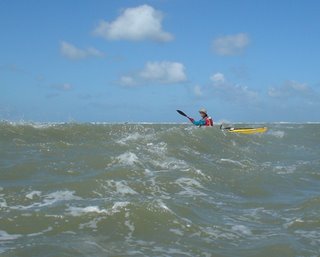
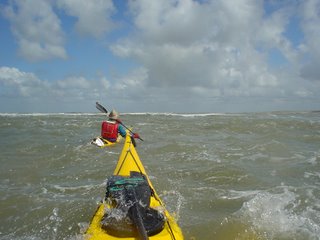
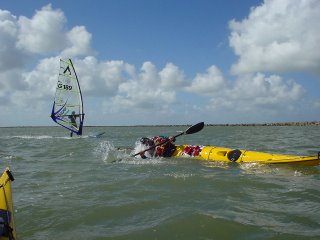
That’s partly because of the presentation of the weather conditions. The daily marine weather forecast suggests it was all very heavy. Ok: it was not comfortable. It was pretty cold (10-13 degrees Celsius), but the wind was (mostly) not that dramatically as the forecast predicted. The marine weather forecast regards the whole German Bucht, the region of the Ostfriesisische Inseln is somewhat sheltered with winds from SW to W. So we could paddle every day, only making longer trips was out of the question. The most heavy winds (up to 7 Bft) occured at Sunday, when the group was already back home and Govert and I left Spiekeroog as some of the last kayakers. Just an hour before us Freya, Bernhard and Andreas took off for Neuharlingersiel. They were towing the 3 Greenland-kayaks of Freya and had a very hard job.

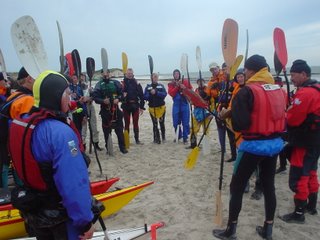
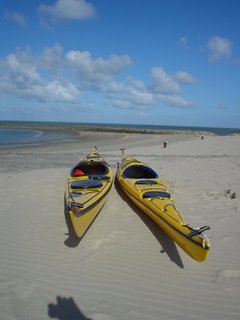
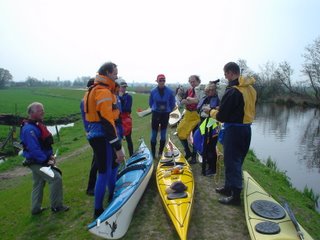
Sundaymorning, ready for leaving Spiekeroog

The main point why I am not totally content with my text, is however because it only describes the “technical” program of the course. And the pleasure in organising and guiding a week like this is not just working through an interesting “educational-kayak-program”. The essence lies for a big part in the social element: working and living close together with a bunch of individuals that become a group within a few days. I find it difficult to express by writing (in English…) the atmosphere of the week. So many things make the difference: The beautiful and restful scenery of Spiekeroog. The people in and around our group: Lars and his relaxed camping shop/café at the campsite. Old Laramy - the pub where we finished in the evening. Discussions with Silke about German economics and politics, with Bernhard about the German and Dutch kayak-philosophy. The stories of Kai and Anke travelling around the world. Hakola first leading the third kayak-course in his beautiful built Greenland-skof-kayak, and later coming back with his family in an original Umyak. All the other people I don’t mention now. And the outstanding culinary qualities of the German cooks: we had a great stylish dinner in the restaurant Inselzauber, and the absolute recommendation is Siwalu. The “Kutterscholle nach Finkenwerder Art” accompanied by great glass of wine “Gewürztraminer” are in itself a reason for a visiting Spiekeroog.
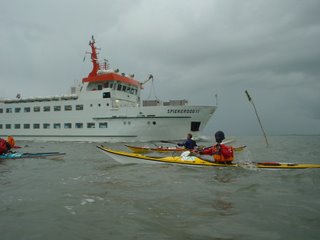
Let's finish the Spiekeroog report with a photo-impression.

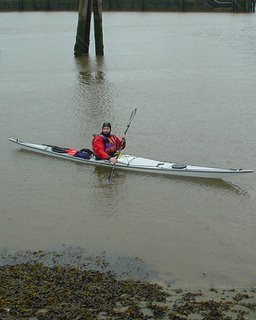
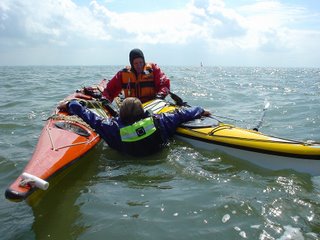
Preparing for praktizing the high brace with support
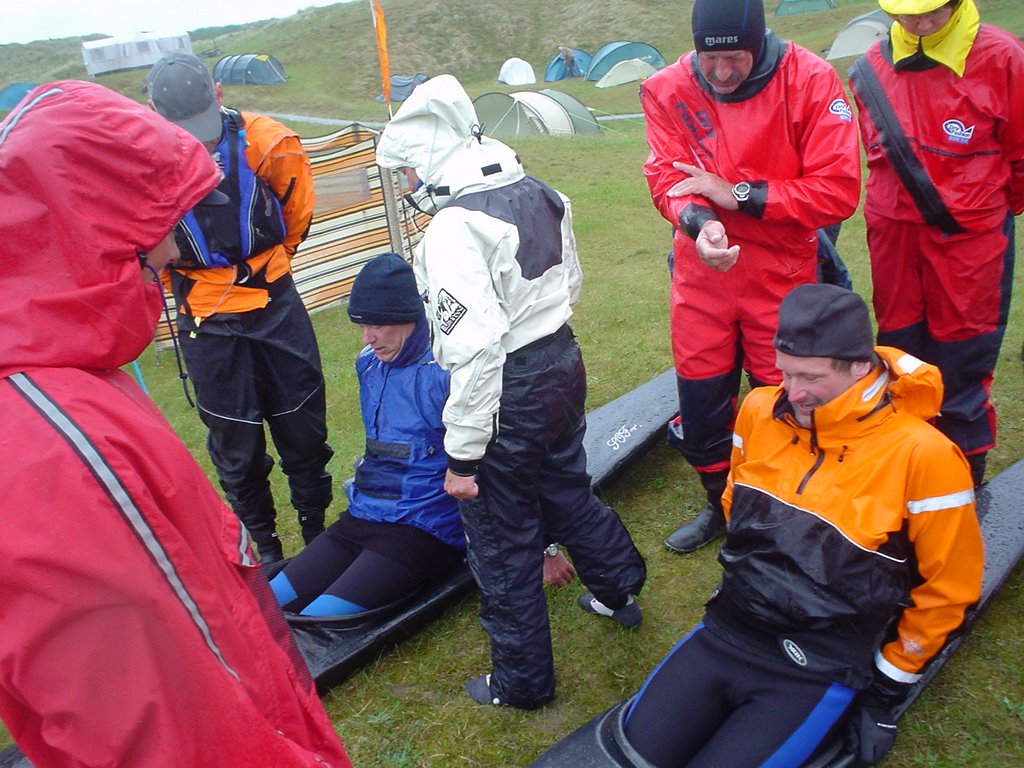
Playing Cinderellas' shoes with Freyas' kayaks
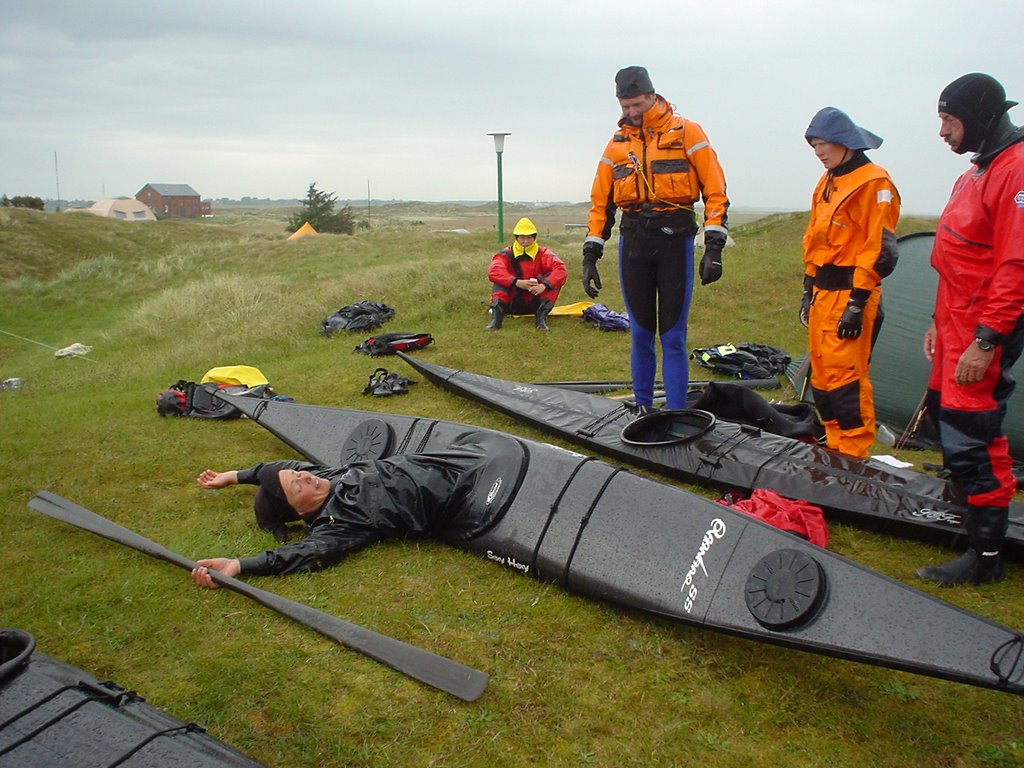
Balance brace on the green
Forward stroke with Bernhard
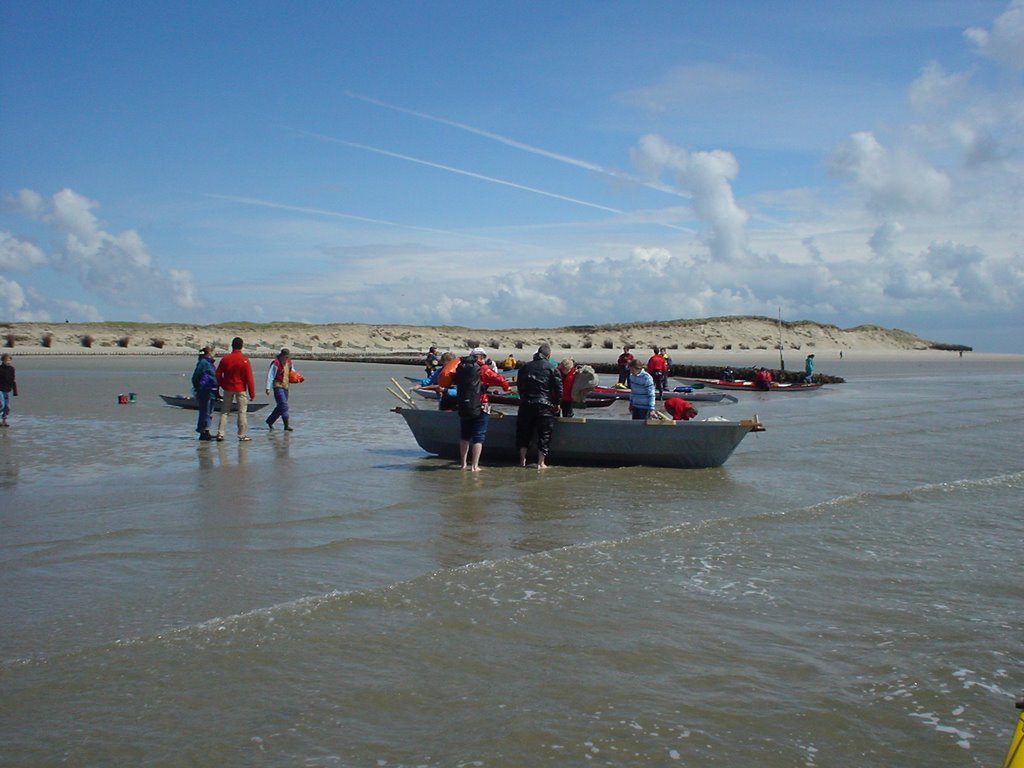
Family Hakola arriving with Umyak
Back in Neuharlingersiel: fish and chips

Wednesday, May 31, 2006

Die Paddelleine - the paddle leash

paddleleash
One of the subtile differences between the Dutch and German seakayaking philosophy concerns the paddle leash. I have never met a Dutch seakayaker with the paddle on a leash. Within the Salzwasserunion it's compulsory. At our course with Dutch and German participants this situation caused some confusion and even some commotion.
My personal view on the leash-thing is quit indifferent. With or without paddle leash: there is no excuse for losing your paddle! Dutch kayakers are trained to keep a hand on the paddle all the time: also in a rescue situation. When you have difficulties with this, a paddle park or a paddle leash can help. So when you feel better with a paddle leash: use it! It's up to you!

In our mixed course I noticed that the German paddlers -in the beginning- didn't know what to do with the paddles of the Dutch victims in a rescue situation. That's no wonder as they were not trained for this situation. They soon got used to it. On the other side: I must admit that some Dutch paddlers did loose contact to their paddles during the excersises. Grrrr... They should train somewhat more ;-). OK: using a paddle leash makes handling a rescue situation easier... And when you use it the right way it's not in the way while paddling, rolling or bracing.
Contra the paddle leash might be (the fear for) a chance of strangulation, and it can tangle around all kind of things... Again: Make your own decission.

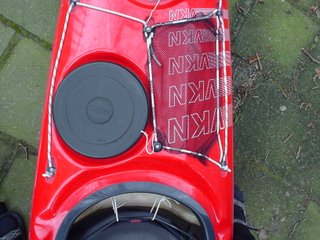
I have a short line with two carbiners on the front deck of the kayak. It's meant for short tows, or to tie the kayak up when it's floating on the water. But in a rescuesituation I can wrap it around the paddles of myself and/or the victim and use it as a sort of paddle park. The idea is not original: Atlantic Kayak Tours even sells prepared lines for this use...
The picture above shows a very sophisticated (and expensive) NRS-Paddle leash. However you don't have to spent much money: it's very simple to make one yourself (don't forget a quick release option).

PS:
At the end of the Spiekeroog course two Dutch kayakers were paddling with the paddle on a leash.

Spiekeroog day 1-3

Saturday 20-5-2006
The meeting with the group at the slipway in the harbour of Neuharlingersiel was planned at 2.00 PM. It’s a 350 km-ride from Woerden to Neuharlingersiel, so starting the trip at 9.30 AM should have given more than enough time. Yet it became a close finish. We arrived exactly at 2.00 PM. Navigation on the road requires some attention, we missed an exit and almost finished in Cuxhaven... It’s a shame: two kayakcoaches 40 degrees and 30 miles off the course..…

Everybody arrived in time in Neuharlingersiel and started unloading the kayaks and sorting out the gear. Rolf (touring-guide from the SAU) was in Spiekeroog and arrived in style by seakayak in Neuharlingersiel. He paddles a unique kayak: self-designed and -built, inspired by the original hard-chined Greenland kayaks. I love the looks (later I made a test paddle: it made a good impression).
It was rainy and windy. We used the waiting-room of the ferry to make acquaintance with the members of the group, and divided the group in two sub-groups for the crossing to Spiekeroog. As we departed at high tide at 6.00 PM wind was decreasing and we had nice paddle to Spiekeroog under a threatening dark sky.

Sunday 21-5-2006
Seewetterbericht Deutsche Bucht 6.40 AM: SW-5/6 Bft, later 7 Bft
High Tide 6.42hr, Low Tide 13.02hr
Due to the weatherforecast we made a slow start. Conditions proved to be better than expected: 4-5 Bft. We used first paddle to get familiar with wind and waves from different directions and paused at the north side of Langeoog.

After the turn of the tide we paddled back to the beach at the campsite were we did the full program of recoveries and rescues. German-Dutch communication was very intense with the rescues… And that was not only because the German participants were not used to the Dutch that didn’t have their paddles on a leash…
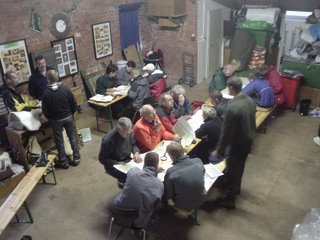
The evening program in the old rescue-boathouse was dedicated to trip-planning.


Monday 22-5-2006
Seewetterbericht Deutsche Bucht 6.40 AM: Gale warning, S-SW-5/6 Bft, gales up to 8 Bft
High Tide 7.56hr, Low Tide 14.11hr
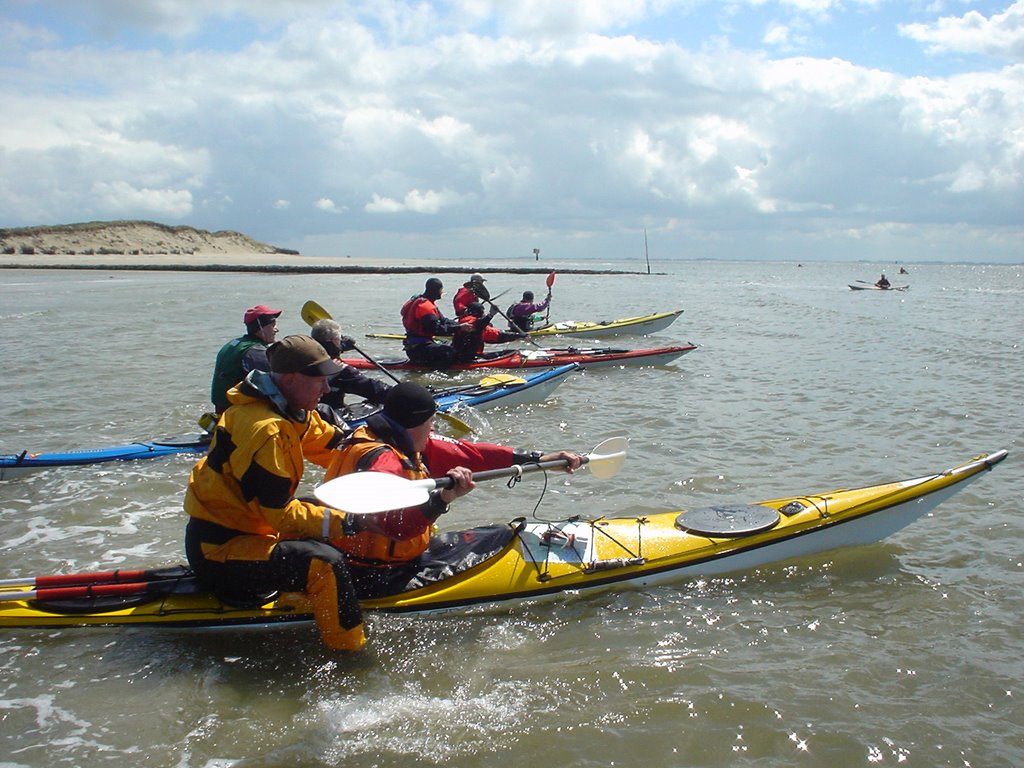
Again there was no reason for an early start. Govert did a workshop on the beach on the forward stroke.

On the water towing under rough conditions was the main issue. I paddled with my group further out at sea, but wind and tide were that strong that we hardly made any progress. In the afternoon we sat in the boat-house again for a First Aid lecture by Stephen.
Tuesday 23-5-2006
Seewetterbericht Deutsche Bucht 6.40 AM: Gale warning, SW-7/8 veering NW, decreasing 5/6 Bft, later SW 6, gales
High Tide 9.10hr, Low Tide 15.27hr

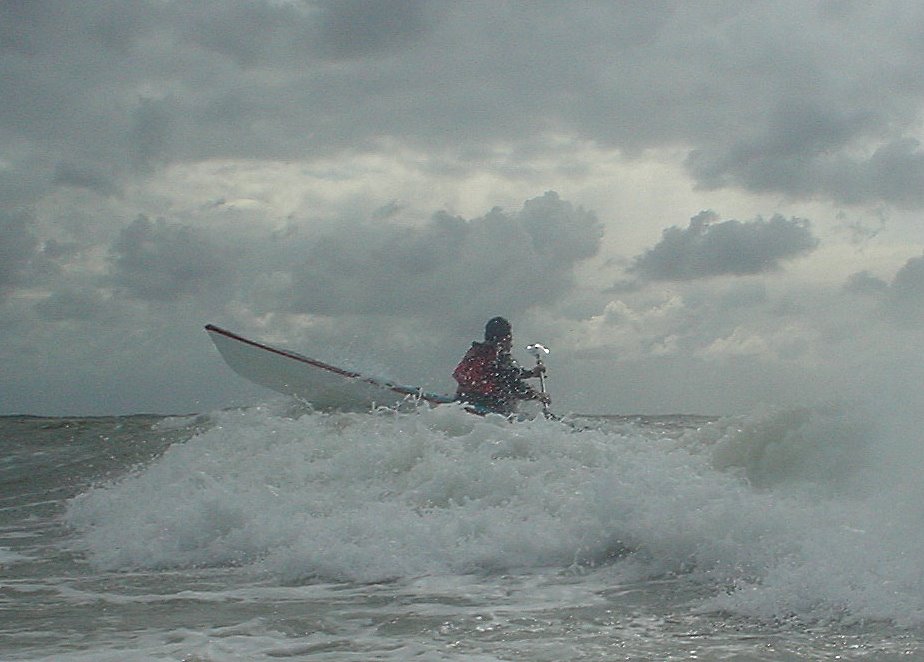
You get used to everything, even to horrible weatherforecasts. We noticed that everyday after midday wind decreased. So this morning we started in the boathouse again: to work on the theoretical exercises the SAU-participants had prepared. In the afternoon we paddled out to the Robbenplatte to exercise landing in the surf zone. Everybody enjoyed playing around. On the way back Stephen simulated an accident. Kaat acted immediately, but Stephen had learned a lot of the Dutch kayakers and annoyed Kaat by making a mess with his paddle. The group had a lot of work collecting all the gear. At the camp-site it was raining so heavy that we did the evaluation of the day in the women toilet…

Tuesday, May 30, 2006

Impressions of the NKB-SAU Spiekeroog course


Sunday I posted all my pictures of the course. And, as there is hardly any limit to digital photography with the giant capacity of memory sticks today, that's a lot of pictures. One can have too much of a good thing. In Dutch we say: "je ziet door de bomen het bos niet meer” - you can't see the wood for the trees. So it's time for a quick-guided tour!

The course was a pilot-project: the first seakayaktraining ever organised by the Dutch NKB and German SAU together. We wanted to learn about our mutual standards, the level of skills, the coaching styles, the drive of the German (resp. Dutch) kayaker, and to get more familiar with the Ostfriesische Inseln – the German North Sea coast. Above all, I wanted to have a good time with an international group of kayakers.
Back home, I conclude there is a lot in common between SAU and NKB. The demanded level of skills for the certificates Zeevaardigheid and Seebefähigung A is almost equal. Both certificates base on the BCU 4 Star-standard. Perhaps the Dutch accentuate a bit more the practical experience (e.g. in surf) while the Germans pay some more attention to the theoretical preparation of the pupils. But those are minor differences.
It’s difficult to say anything about differences in coaching styles as Govert (NKB coach) replaced the SAU coach Urs (Urs couldn’t do the course because of medical reasons). So it’s difficult to compare, but we got some remarks and feedback of the German participants and assistants. My impression is that the NKB-style is more based on learning by doing.
Personally I find it very important in a course to create an atmosphere where the students are stimulated to experiment. The best way of learning is experiencing yourself if your solution works. The student drives his own learning; the coach accommodates and facilitates this by creating learning situations, asking questions and giving feedback. I prefer a non-directive style, but of course it should be appropriate to the situation, the group and the learning goals. Bernhard (SAU Coach) joined the course for the last two days for the examination. I noticed our ideas about coaching go in the same direction.
Govert and I divided the group of 17 participants. I coached my group together with Stephen (SAU assistant). That was a great experience! I am astonished how natural it worked out: I like the way Stephen handles a group of people, it contributed so much in creating the right atmosphere. Thanks Stephen!

And now up to our program. What did we do? Not what we intended to do. We wanted to make a multi-day trip in the course. The weather (forecast) didn’t allow us. Day by day we adapted our program to the weather situation. It was cold and very windy, yet we were on the water every day. Sometimes the conditions, waves and wind, were above 4-star level: not ideal to exercise the perfect technique, but very good to experience different sea-states…

To be continued:
After this “general introduction” I will describe the daily program in the next posts.

Monday, May 29, 2006

Back home: the "Spiekeroog-pictures"


Yesterday Govert and I returned from the Spiekeroog course. It was a rather cold and stormy week, nevertheless we had great fun with the German and Dutch group. A report and more pictures will follow soon, but first I am busy drying and sorting my gear (while work and family life goes on...).
In particular for the course members: all my pictures (205 pics: good and bad, unsorted, uncensored and unprocessed) are uploaded to Mijnalbum.nl . You can download the photos by the button "opslaan" in the frame on the left side of the photos.

Friday, May 19, 2006

Gone paddling...


Next week no blogging, but paddling in Germany: the Spiekroog course -> a coproduction of the NKB and the Salzwasserunion.

De zee neemt.... In memoriam


Between the kids-party for Jelle's Birthday and me busy packing the last things for Spiekeroog, I read about the terrible accident at the Volvo Ocean race. Hans Harrevoets died. Condolences to the family and the team.


From: http://team.abnamro.com/ :
5/18/2006 8:24:20 AM GMT TRAGEDY ON ABN AMRO TWO
Hans Horrevoets, one of the Dutch crew member aboard ABN AMRO TWO, died earlier this morning after being swept overboard from the boat.ABN AMRO TWO was sailing downwind in 25 – 30 knots of wind under main, fractional spinnaker and staysail. Seb Josse, Skipper of ABN AMRO TWO was at the helm, Hans, 32 of the Netherlands was trimming the spinnaker sheet, Nick Bice, Andrew Lewis and Lucas Brun were also on deck. The boat nosedived down a wave and water came washing back down the deck, when the water cleared Hans was no longer on deck.ABN AMRO TWO Navigator Simon Fisher explained the incident, “Immediately Seb hailed a ‘man overboard’ and we initiated man overboard procedures and we put in place the GPS positioning. The boat immediately turned around and began to search for him, meanwhile raising the alarm on shore. After Hans was found he was lifted back on board and the Accident and Emergency(A&E) department at Derriford Hospital, Plymouth, UK was notified that we had a major medical emergency and to stand by. Unfortunaly our attempts to resuscitate him were not successful."ABN AMRO TWO Skipper Sebastien Josse said, “We are all devastated by the events that took place this morning and all our thoughts are for Hans’ family. Throughout the whole MOB (man overboard) procedure the whole crew handled themselves calmly, professionally and with the utmost maturity. It is with deep regret that we were unable to resuscitate Hans.”Jan Berent Heukensfeldt Jansen, Managing Director of TEAM ABN AMRO said, “We are all shocked and devastated by this terrible news and our thoughts now are very much with Hans’ family. We are all aware of the risks that sailors face but nothing can prepare you for this kind of tragedy. My thoughts are also with the crew who I understand behaved in the most professional manner and reacted immediately and I wish them a safe passage home.”Glenn Bourke, Chief Executive Volvo Ocean Race said, “All of us at the Volvo Ocean Race are deeply saddened to learn of the loss of ABN AMRO TWO crew member Hans Horrevoets. At this time our thoughts are with Hans’ family and friends, his fellow crew members and all the members of TEAM ABN AMRO. Ocean racing carries inherent risks and we do our utmost to minimize those risks with the mandatory safety equipment we have on board. However, when an accident like this occurs it is a shock to everyone associated with the race. The Volvo Ocean Race family is a close-knit community and we will all lend whatever support is needed at this tragic time.The crew are no longer in racing mode but are making their way to Portsmouth as quickly as possible and will make a decision on further participation in the race during the Portsmouth stopover.

Saturday, May 13, 2006

Packing for Spiekeroog

With one week to go, I started to sort out the gear needed for the seakayaktraining at Spiekeroog. The more stuff you get, the more choices to make. The first is: "which seakayak?" That wasn't difficult: the Valley Pintail (because it's new..). This limits the amount of gear I can take along. The Svalbard has more volume.

I want to travel light. But there are many important things you must take along, and there are so many things that might be useful. First I collect all the gear I could possible use in our guest room. Next few days I am going to select the things I leave at home.
"What to wear?" -> This is one of the new choices: until last year I always used a wetsuit, but now I have also got a drysuit....
"Which tent?"-> The two person Birdland-tunnel, or the Northface solo-shelter I bought some time ago in Berlin? The last one packs smaller and weights the half. But I haven't tried it yet...

Birthday celebration

This week both Raphaela Legouvello and Freya Hoffmeister celebrated their birthday at sea. Congratulations ladies! Raphaella is making a solo crossing of the Indian Ocean on a surfboard since 8 april this year: from Australia to the Reunion Islands, 6500 km, 70 days, it sounds very long and lonely... With modern means of communication however contact is no problem: you can belisten her daily phone sessions on Raphaellas’ website every afternoon. Freya paddles with Wendy Killoran along the south coast of Newfoundland. Wendy is doing a circumnavigation of "the Rock", Freya joined her for two weeks. Next week she takes the plane back to Germany and comes to the meeting of the Salzwasserunion at Spiekeroog. I am looking forward to meet Freya there! Though I should be careful as Derrick asked her to smack me on the head ;-)

I am also often travelling around during my birthday: september is a busy month with the Seakayakmeeting of the NKB at Vlieland, the PZH - race-biking weekend in the Ardennes, and…
This year the NKB-seakayakmeeting is the reason why I celebrate my birthday without family. But that’s only a few days and a few miles away from home. More serious is that I am not at home at the birthday of my twelve year old son Jelle next week (because of the Seakayakcourse of NKB en SAU at Spiekeroog). We have planned his kidsparty some days earlier, but I will not be home in the weekend when the family comes. Not quite the way to make yourself popular with grandmothers and granddads… Poor Janine.
Jelles’ biggest desire for a birthday-present is a mobile phone. The bygone weeks I couldn’t pass by any telecom-shop with Jelle. I never knew there are so many of those shops! Mobile phones are very important for a twelve year old kid. Some adult kayakers share this interest: Wenley and Derrick recently posted items about important specs of their favourite phones. According to Jelle, they are both riding the wrong horse: it isn’t waterproofness, durability or sturdiness that counts: a phone should be "cool, bling, foldable" and above all offer a lot of games! Jelles’ process of selection is inimitable, but this morning we finally succeeded.
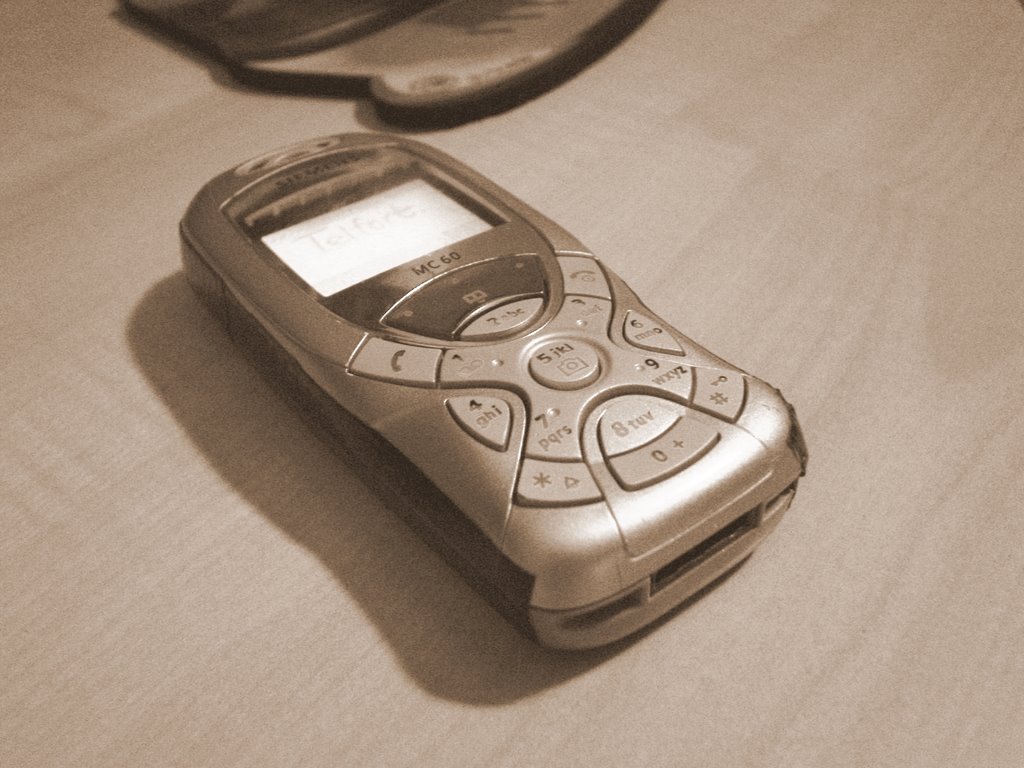
My own phone doesn’t meet any of the specs of Jelle, Wenley nor Derrick, but with duck-tape preventing it from falling apart in pieces, it’s the one and only real kayakphone!

Wednesday, May 10, 2006

Handy Hint: compass on the hatch cover

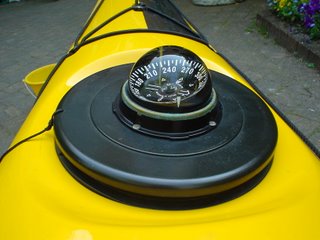
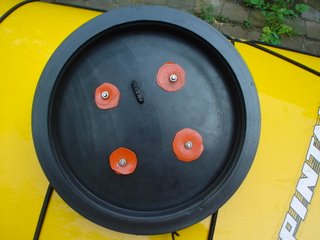
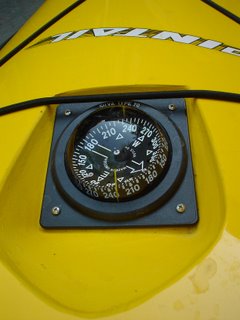
On special request of Jörgen, today a post about the "compass on the hatch-cover". Two of my previous seakayaks, the Meridian and the Svalbard, didn't have a factory fitted recess on the deck for a compass. I didn't like to cut holes in a virginal gel-coated polyester deck, so I bolted a Silva 85 compass (= Nexus 85R Marine) on the cover of the front hatch: a simple but effective solution. In the beginning I was afraid this position was to exposed for damage, but in over 6 years of intensive use, I never had any problem with that. Advantage of the Silva 85 is that it is a lot bigger and -with larger numbers- it is easier to read than the (mostly on seakayaks used) compasses of the Silva 70-series.


Mounting the compass is easy: the rubber of the VCP-hatches fits tight around the bolts so there won’t be any leakage. Be sure to use non-iron bolts and nuts near a compass!


To compare: the Silva 70P on the Valley Pintail with a recess in the deck:

Tip: Lots of Handy Hints on seakayaker.co.uk ; very useful site!

Sunday, May 07, 2006

The Svalbard is back! ... and just another toggle pic

The Carfree Girls will be upset: today I made more than 150 km's by car with a kayak on top, just to do some shopping. It's a pitty that kayakshop Arend Bloem isn't any nearer to Woerden. My excuse for visiting Arend this time was the urgent need for (1) a new sprayskirt for the Valley Pintail and (2) some extra waterproof luggage bags. I must get my gear ready for the kayakcourse on Spiekeroog. Arend and his crew have seen me often lately. Sure they don't mind!

In general I am not particullary fond of shopping. One exception: the kayakshop! Shopping at Arend Bloem is a social happening, almost everytime I meet kayakfriends looking for gear. And Arend has always interesting new gear in his shop. Today it was the first Svalbard from MSC. The Svalbard is a Dutch design seakayak that Jan van der Sluis (in Holland and Germany well known for his perfection in building kayaks) built. Some years ago however, Jan stopped building kayaks for Kajakcentrum de Biesbosch. But now the Svalbard is back again. Made in the Czech Republic by MSC in coöperation with Jan, for about half the prize it did cost when it was made in the Netherlands... The first impressions of the building quality are good, finishing seems to be at least comparable to the renown British Seakayaks. Comparing with my Svalbard-kayak built by Jan, MSC has simplified some complex details like the curved bulkheads and the water draining hole at the compass-recess, but that doesn't take away from functionality.
Ok, it is not a very original idea to produce in a "low-cost"-country an old design again, perhaps it's good for the prize, but in potention it kills innovation. Said that, I must plead for MSC. They really do more than just imitate. They have added improvements and new options to the Svalbard design (like the possibility of adding a rudder, and a small day hatch in front of the cockpit), and they will also produce a complete new (Dutch design) seakayak: the Vestvika.

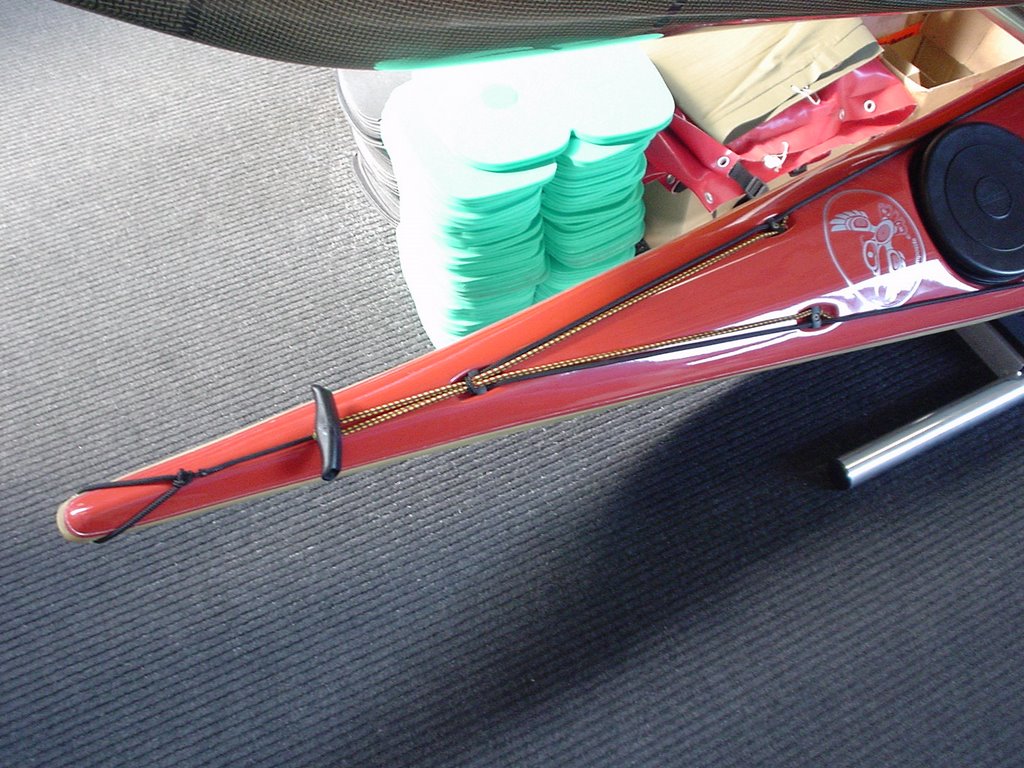
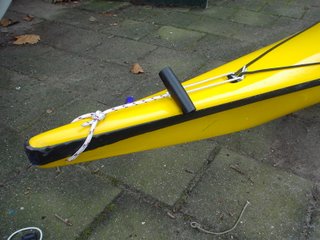
The picture above shows a detail of the MSC Svalbard (click on the picture to see the details). The toggles are fastened similar as I described some time ago for my Pintail: with a long single rope. Interesting here is the mounting of the elastic cord that holds the toggle in its resting postion. I did this with a short loop from the front cleat to the toggle. Problem with my solution is the short distance: I had to experiment with elastic cords of different thickness: the cord must be elastic enough to stretch from the resting position of the toggle till the pull out position. Only a thin elastic cord was elastic enough. On the MSC Svalbard the elastic cord is not fastened on the front cleat, but on the cleats in second position. This gives the elastic cord more length, so the relative difference between the resting position and the pull out position is smaller. The advantage is you can use a stronger, less elastic shock cord.

Friday, May 05, 2006

To paddle or not to paddle?


29-4-2006 Voordelta, Aardappelenbult: René testing the new Vestvika.

I will finish this post tomorrow. René has already written a report of our trip on his blog -> you can read there more about my doubts and mixed feelings on cancelling a planned seakayaktrip. Here are some pictures of this sunny (but very cold!) day on a confusing (nl: "warrige") choppy (nl: "woelige") sea.

It was my first saltwater experience with the Pintail. It did a good job: it's a fun kayak to paddle under these conditions, reliable and manoevrable.

Valley Pintail (left) and VKN Svestvika (right), ready for first saltwater launch.

Friday, April 28, 2006

Beatrix, Asterix and Obelix


The day before Koninginnedag is Birthday honours day: this year 3524 people were honoured by Her Majesty Queen Beatrix. One of the most surprizing decorations is Albert Uderzo as "Ridder in de Orde van de Nederlandse leeuw"; one of the highest honours. Only 19 people became "Ridder" (= Knight) in this Order. One of the considerations with this decoration is "the importance of Asterix for the propagation of Latin language and culture"...
Uderzo is undoubtly a great artist. But it's a Frenchman! What has he done with the Netherlands? There is no album of "Asterix in Holland". There is one album "Asterix in Belgium". But Belgium and the Netherlands became seperated in 1830. Dutch and Belgians are different. Belgium has its own Royal Family and its own Royal decorations. I think Beatrix wants Uderzo to make a Dutch album in the last years she reigns this country.
With her name it is strange indeed that Uderzo didn't came earlier to this idea. And historical there are may reasons for it. The Limes cuts the Netherlands in two, we had the Friezen and the Batavieren, Woerden had its Castellum: enough stuff for a good album.

Right now I feel like Obelix in the picture above. I have canceled tomorrows seakayaktour in the Voordelta. The weatherforecast says 5 Bft, gales up to 7 Bft, a chance of showers of hail and thunderstorms in the afternoon. I don't like to disappoint enthousiast people, but with these expectations, water and air temperature both around 10 degrees Celsius, it's not responsible to go out at sea with a group of almost 20 kayakers. I do like a challenge once in a while, but not tomorrow with a group under my responsability! Like Obelix says: "you live near the sea but you are not allowed to have the pleasure of it.... " it's Sh**.
The stupid thing is: it's just an expectation. Maybe wind slacks and conditions are good tomorrow... There is a saying in Dutch "Thuisblijvers hebben altijd ongelijk" -> those who stay at home are always wrong. Mostly that's my device. But that's mostly, not now.
I have no doubts with my decision. Yet it still feels bad.

I am going to drink a Guiness and watch the so called "Sea Kayaking Porn": This is the sea - the great video Justine Curgenvan made.

PS: next week I have no internet-connection. It will take a few days before I can add new posts in this blog.

Escaping Koninginnedag...

Prinses Máxima der Nederlanden,
picture of the Rijksvoorlichtingsdienst


The Dutch love their Royal family. Especially since Princess Máxima married Prince of Orange Willem Alexander and introduced Argentinian latin temperament. Many Dutch enjoy "Koninginnedag". Some Dutch however want to escape it. Perhaps that's the reason why there are so many entries for the seakayak tour in the Voordelta tomorrow.

This is what 20 seakayakers miss:


This is what they might get instead:


Just like the Queen, I do hope the weathergod has a good temper. The forecast is uncertain, some weathersites predict NW 5 Bft with gales up to 7 Bft in the afternoon. This evening I will listen to the Marine forecast and definitely decide what to do. For the participants: please have a look at www.zeekajakvaren.tk this evening!

PS:
1. I have repaired and added some links in last posts. Thanks to Jochen and René for their comments on missing links;
2. Lately René has added a new English article to de zeekajaksite;
3. Axel was a few days in the Netherlands and has updated his blog with reports of his trips in the US and Mexico. He just left for the Anglesey Sea Symposium...

Wednesday, April 26, 2006

Kayak customizing - toggles and ropes

In the post about the prepatory meeting for Spiekeroog with the check of the kayaks of the participants I mentioned my own Pintail also needed some modifications to become real seaworthy. It's a minor thing, but an important thing: the toggle-thing!

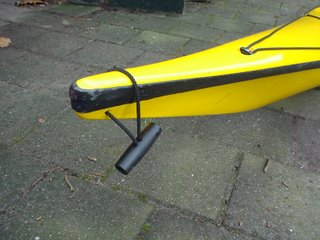
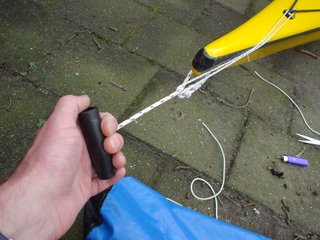
First a word about "what's a toggle for?" Toggles are useful for transporting an (unloaded) kayak by two persons, but that's not what they are really meant for. Toggles should, above all, give safe grip to your kayak in a capsize situation. As a kayak can spin viciously in moving water the rope on the toggle (1) should be long enough to allow the kayak to spin around without squeezing your hand between the kayak deck or hull and the toggle and (2) the toggle should be fastened to your boat in a way that makes it impossible to put the hand into an open loop (-> risking trapping the fingers in an ever tightening thumbscrew situation).
Every designer, builder and supplier of seakayaks knows this since years. And yet...

The factory fitted toggles on the Valley Pintail:


Fingers can get trapped easily:
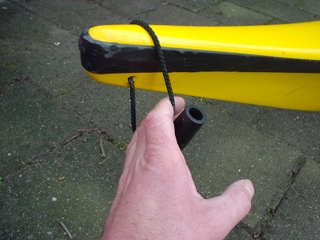

After customizing. The elastic shock cord prevents the toggle from hanging in the water:

The kayak now can spin freely around its axis and the single rope prevents trapped fingers:

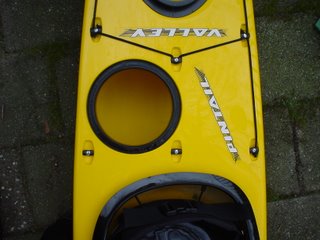
There is some more rope work on the Pintail:

Someone at Valley had good ideas about positioning the cleats. But why didn't Valley fit any ropes or shock cords? It I think it was that dramatic shortage of rope in Britain last year ;-) The situation in Woerden wasn't any better today. This morning I couldn't find the black rope and shock cords I got with the Pintail... So now the Pintail has a white toggle line on the bow and a red on the stern... And I will fix the other rope-work another day. I want to outfit it just like the red Svalbard:

Few hours later I found 6 meter of black rope and shock cords in a wardrobe?!

More about kayak outfitting:
1. spring is "international kayak customizing time": see the blogs of Derrick and René.
2. René has written a first impression of a interesting new seakayak: the Vestvika.
3. Derrick wrote last year an interesting footpump in a rotomoulded kayak.

Eating fish


picture from RVU-educatieve omroep www.rvu.nl

He kisses a codfish, seduces a young Dover sole, walks at the bottom of the sea and discovers the use of a pair of scissors to get a fish in pieces.
Klootwijk aan Zee is a new series on Dutch television about fishing, eating, and stories.

Wouter Klootwijk is reporter, writes book for children and publishes in the NRC-Handelsblad. I like his style, especially the culinary reviews he wrote under his nom de plume Ben de Cocq (De Boer & Cocq). So I am curious about his performance at television. The concept of the program isn't original (it reminds me of National Geographic series like "Atlantic Britain" with Adam Nicolson) but it sounds very promising.

I missed the first broadcast yesterday. I was to busy mailing for the kayak thing. But there is a repetition: tomorrow at 12.00, ned 3. I am going to set the video right now (before I forget to do it).

Monday, April 24, 2006

Sightings of cetaceans


In june 2004 within 2 weeks 2 giant sea-mammals, a humpback whale (nl: bultrug) and a sperm whale, stranded on the isle of Vlieland. I find a dead whale on the beach an impressive but also very sad sight. Fortunately such a stranding giant is rather seldom. However: strandings of cetaceans are more regular then I thought. Only in 2006 already 143 cetaceans were found dead on the Dutch coastline, most 3 or 4 ft. porpoises (nl: bruinvissen) and some delphins.

Lately the number of ceteceans in the Dutch part of the Northsea seems to be increasing. And though they are very fascinating animals (it's always nice to see them) it's not clear if we should only be happy about this. Climate change, alteration of sea currents and temperature and sea level rising and can have a dramatic impact on live in the coastal zone of the north sea (... this sounds like work, better stop preaching now... ;-) .
At last meeting of the NKB sea kayak coaches Leo van der Vaart made a call to report sightings of ceteceans to Kees Stamhuyzen of the Dutch Seabird Group (NZG). Kees has established the NZG-Marine Mammal database to document and record live-sightings of Marine Mammals in and around the Netherlands to be availaible for consultation by anyone interested in studies of marine mammals. Data of strandings are not logged, do contact Naturalis in Leiden for any records. For live-strandings of marine mammals, get in touch with Dolfinarium Harderwijk.

The picture above this post makes me shiver. The dead Humpback whale stranded in 2004 on the Army base of Vlieland. Off course I understand it's necessary to remove the dead corps, and you have to use big gear to do so. OK, it's rational, it's good. But somehow the feeling is bad, it doesn't fit, an image of a tank dragging the whale. Respect, dignity? Finally the whale got a good last restplace: it's skeleton is exposed in Ecomare, the center for Wadden and North Sea on Texel.

When you came up to here, reading this post about dead whales: you must have a look at the pictures of Douglas Wilcox of the Solway stranded fin whale. It's also a sad sight, but these pictures of a seakayaker carefully approaching the dead whale, show respect for the dead corps, dignity.
And as you have found Scottish Sea Kayaking Photo Gallery, have a look at the other trip reports. Scotland is sea kayakers dream! Douglas makes very good pictures. I was surprised to read he uses the same digital camera as I do: the Sony DSC-U60. I totaly agree with Douglas' enthousiast opinion about the pros of this camera for making seakayaking pictures.

Sunday, April 23, 2006

Countdown for Spiekeroog: 4 weeks to go...


Today was a preparatory meeting with the Dutch participants of the 4-star course at Spiekeroog (Germany) in May. Because I hate to spent a whole sunday indoors, and to offer more than just a day of gathering and talking, I invited the group to start in the morning with a little kayak tour around Woerden. This also offered a good occasion to check the gear. Just in time: there are four weeks left to adapt the kayaks to NKB and SAU standards. I should be ashamed myself: as a coach I am supposed to give a good example, but I haven't customized my new Pintail yet. I think I will do it this week: next the saturday is the first launch of the Pintail in salt water.


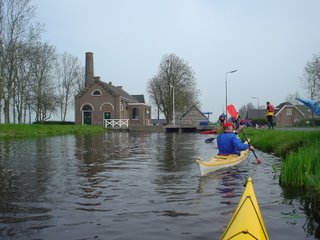
It was a odd sight: 10 complete outfitted seakayaks in the small ditches and canals around Woerden. It's overdone, but we had fun with it ;-)
Maarten surprised us with a beautiful self-made greenland-kayak. He won't use it at Spiekeroog; it doesn't meet modern safety standards. But there sure is a lot of interest for a greenland style rolling class with Freya!


Blogger upload tool refuses to add more pictures. To see more kayakers and cows: click here.

Wednesday, April 19, 2006

I Love Sweden: Skim Kayaks in the Netherlands


Här kommer Pippi Långstrump,
tjolahopp tjolahej tjolahoppsan-sa
Här kommer Pippi Långstrump,
ja, här kommer faktisk jag.
The Pippi-song, Astrid Lindgren 1949

.
I love Sweden. Though I have never been there. But imagination can do a lot. Over the years always something with Swedish design or lifestyle fascinated me. My addiction started in the early 70's with the TV-series of Pippi, Annika and Tommy. Some highlights after Pippi were: Abba, Saab 96, Ikea, Smorebrod, Midsommerdagen, Anna, Allemansrätten, Mrs. Brundtland, the Swedish social security-model. Last year I had the pleasure to lecture a Swedish delegation from the region of Örebro about Dutch water management ->very nice people! Back to seakayaking: Swedish coast must be great, and Sweden offers some interesting seakayak-designs


I suppose I have pleased some regular visitors of this blog: since there is a link to my blog on Kajak.nu 15% of the visitors of this blog is from Sweden. Kajak.nu is the website and blog of Erik Sjöstedt and Pia Fransson: it looks very good, it's a pity I can't read Swedish...


And now to the motive for this post. Today I received an email from Peter Grobbee. Peter wrote that he will be the Dutch distributer for Skim Kayaks. Skim is new on the Dutch market and produces two seakayaks: the Distance and the Dex. The Distance is "a long-range kayak for those who aren't discouraged by a little blizzard. The boat's length and profile give it a sufficient loading capacity in combination with seaworthiness and reliable tracking in hard wind and rough seas (=orig. Skim-text)". The Dex is "a playful and nimble kayak for day and weekend trips where high seas and surfs are more than welcome. A boat for those who appreciate contact in leans, edges and manoeuvres. Low volume. Low profile. Tight cockpit (= orig. Skim-text)."


Both kayaks offer an interesting deck and hull design and detail-solutions like an integrated towing system on the deck, intern secured hatches, "glow in the dark"- deck lines, special rescue straps for a paddle float rescue (but I don't favour the paddle float rescues with a fixed paddle...). And they look good: Swedish design (with one little exception: the racing stripes: why? Starsky and Hutch?)!
I am happy with Peter's invitation to test the kayaks: I am especially curious about the Dex. It should be a very playful kayak! Have a look for yourself on Zeekajaks Nederland.
Picture of the Skim-detail used with kind permission of Peter Grobbee.


PS: Reading this post I realize that Gro Harlem Brundtland was prime Minister of Norway, not Sweden. However: a great scandinavian lady we should honour for introducing the broad political concept of sustainable development! (she could have been Swedish...)

We got very dirty with Easter..

.. but we also had a lot of fun! The Easter Weekend we had a family reunion in the Eifel (Germany). Early in the morning, when the rest of the family was still waking up, Janine and I made went out to make short MTB-trips. Rain, mud...

We stayed at Einruhr. That's a small place at the Obersee; one of the Barrier Lakes of the Rur. It sounds like a perfect spot for watersports, but as the Obersee is a reservoir for drinking water, any recreational use of the lake is prohibited: the Germans are very straight with regulations. Even swimming isn't allowed. But for hiking and biking it's a perfect spot. Especially because the former Military Camp Vogelsang is since January 2006 no longer a restricted area! Now you can bike on trails that where over 60 years the playing ground for military vehicles. It's a strange idea in such a romantic landscape...

Thursday, April 13, 2006

KNRM - lifeboat-report April 2006


This morning the postman delivered "De reddingboot": the quarter-year report of the KNRM (the Dutch equivalent of the Royal National Lifeboat Institution). It's a fascinating magazine with stories of brave man risking their lives while rescuing sailors under live-threatening conditions.
I always love to read about seakayakers anywhere/anytime, but there is one big exception: please no stories about seakayakers in "de Reddingboot"!
Today's edition containes two reports of operations where seakayakers were involved ;-(

It will be next week when I finish the item I intended to write about these rescue-operations. Now it's bedtime and tomorrow we are going to Germany for a family happening in the Eiffel. No sea, no kayaking, but forest, hills, trails, hiking and mountainbiking (and some social activities with relatives). It could be worse...

Monday, April 10, 2006

Miscellaneous

Not writing in my native language brings me some extra work, and extra fun. Foreign words can be very fascinating. "Miscellaneous", for example, is a wonderful combination of characters. It's so different from our Dutch language. It's a pleasure to look at. Spoken it's somewhat disappointing; the simple sound doesn't match the beauty of the written word.
Today a short post about various (miscellaneous) items.

1. René wrote an interesting addition to my item about the aspects of sitting high or low in a kayak. You can find his comment here. Btw: René has also started blogging in English.

2. The Dutch have a tradition of the "Voorjaarsschoonmaak" (= "spring-cleaning-time"). In real world I seldom join this tradition. But I noticed I made a mess in the virtual world: it was time to clean up the kayak bookmarks in my Browser. I am combining this action with reorganizationon of the previous Dutch Kajakwoerden blog . I am transforming it in a link-list with my favorite kayak weblinks. You can access it by the first weblink on the right side of this blog.

3. Last week I bought a VHF-handheld radio at last. I found that, as a kayak coach, I should be a able to use the Radio legally, so I did the examination for the users-licence and got the appropriate permissions and registrations to use it with a seakayak. It's not difficult to do this, but it takes a lot of procedural steps, time and money. The whole procedure with Dutch administration takes at least 3 months. For the Dutch kayakers I made a description of the current procedures (in Dutch) here.

4. In preparation for the Seakayak course at Spiekeroog, Govert and I visited Urs (a German Sea kayak coach) in Germany yesterday. Now it's definitive: Govert and I will coach the complete group of German and Dutch kayakers in their "Zeevaardigheid/ Seebefähigung" (= BCU 4 star)-training. Experienced members of the Salwasserunion will assist us. I am looking forward to this Dutch-German co-operation! And with the fishing-skills of Govert nobody needs to be hungry!

Friday, April 07, 2006

To sit or not to sit - part 2


I'm just a kid and life is a nightmare
I'm just a kid, I know that its not fair
Nobody cares, cause
I'm alone and the world is
Having more fun than me
Tonight...
Lyrics, Simple Plan: I am just a kid - 2002

I started writing this post post yesterday evening. I wanted to write a follow up on the earlier post "to sit or not to sit" about my experiments with the seating position in the Svalbard kayak. But that was before my son Jelle returned from is his first danceparty at school. He had been looking forward to that party, but he was also very nervous about it. The first time dancing with a girl: that's heavy stuff for a 11 year old boy. I hoped he would have a great time, but alas: he came back quit disappointed. He didn't dare to dance. Such a pity! After Jelle went to bed I wasn't in the mood for continuing this post. And as a matter of fact I am still not. We had a family day today and Jelle got a lot of distraction. Today he went to bed happy again. But to me it's getting clear that a new period appears: "adolescence" with the worries of a teenage kid...

A few words to kayaking though. Some time ago I had a little discussion with Wenley about sitting high or low in a sea kayak. Wenley was thinking about replacing a kayak seat because he found it to high. I mentioned that I prefer a somewhat higher seating position. Wenley challenged me to say something about the mechanics of a high kayak seat.
From a mechanical point of view I admit it's simple: a lower seat brings the center of gravity down, which results in more stability and which should also be an advantage in bracing and rolling. That's one reason why many people replace their fiberglass seat for a lower foam seat. In the early 80's this was the way I was learned to paddle a flat water racingkayak (K1). Pupils that made the step from a training-kayak to a racing-kayak first paddled the very tipsy K1 without a seat with a simple pillow on the bottom of the hull.
But the "ergonomics" is another (and far more complicated) aspect of the sitting position in your kayak. Bringing the seat height higher can make it easier to have good contact with your knees and thighs to the deck of your kayak. It can also make it easier to lean backwards on the deck. With my Svalbard I was surprised by the difference only 2 extra cm's of height make. The better boat-contact and greater freedom of movement made rolling and bracing more relaxed. I also got the impression that the higher seating position invites to a more aggressive and effective high-angle forward stroke. Of course this is very personal and depends strongly on the design of your kayak and your corpus dimensions. But I think it's worth an experiment: lower is not always better ;-)

Sunday, April 02, 2006

A Sunday morning paddle


Newcomers can ask difficult questions. After yesterdays' pool session Suus asked me what the joy of kayaking is for me. I was struck dumb: that's what I am writing about in this blog... I can't give one simple answer to this. Kayaking has so many different aspects. But how do you tell someone who hasn't got the slightest clue of what seakayaking is about? I was just about to take my chance and tell Suus all about it, show her my kayaking pictures, Justines' videos, my kayaking library, and... ;-) But as Janine saw that glance coming up in my eyes, she took action and saved her sister.

So what is the joy of kayaking? Sometimes it's a social thing: having fun with friends on the water, in a pool, at sea or at shallow waters. Today however it was a private thing. This morning I got up early, Woerden was still asleep. I left the Pintail on the roof of my car after yesterdays' pool session. I drove 15 minutes to a little place called Noorden at the Nieuwkoopse Plassen, unloaded the kayak and paddled ahead. First in the lee of the bushes and last years reed. The water was like a mirror until the rain started dripping. The drips on the kayak and the water created an intimate atmosphere. I was alone with the waterbirds. After a few miles I entered another world, the wideness of the Noordeinder Plas. Wind was increasing, gales force 5 and 6 made the water lively. I forgot about the world around me, now it was the kayak and me, and I coursed different directions to test the behavior of the Pintail on windy conditions, paddled to lee shore to find some short steep waves. The Pintail is a playful boat but tracks surprisingly well under these conditions. When I got ready with playing I paddled back to Noorden. Packed the kayak on the car. And had a cup of tea with appletart in the café De Klinker. Here I met the first people: I had been paddling two hours without seeing any other boat on the water. I love being alone, once in a while!

Give me a hand...


Saturday evening was the last kayak-poolsession of this season. On this occasion Kayakclub de Kromme Aar hired all the pools of the sportscenter including the recreational pool (with a magnificent water-slide and a whirlpool!) and friends and family were invited. So we had a great paddle fest. Coincidentally Suus and her daughter Lieve were visiting us, so with our two kids we were six. For Suus and Lieve it was the first introduction to kayaking. Lieve (1o years old) had no restraints at all, but Suus (age ... ;-) first thoughts were: "how do I get in and how do I ever get out of this tight fitting thing- help!" Yet after some short balance acts, edging and leaning exercises, Suus soon was hanging upside down and practicing the hip-flip. The first time she was pulling powerful on my hands. I was surprised how soon she found out that when shoulders and face leave the water last, the hick flick does the work for you. As a matter of fact I even think that physically she didn't need to pull or touch my hands at all for recovery, but mentally: that's another thing...Rolling is a mental thing: "het zit allemaal tussen de oren!"

PS: A Kayak Rolling Primer from Rob Highnell is back on the web!